Posts

Showing posts with the label Anthropology

Science is Fun Fridays!

Image
 Earlier this week we touched on the anthropology of disability, which falls under the Cultural arm. As a whole, the study is of cultural variation among humans.  It views disability as a culturally constructed experience shaped by social norms, environments, and power. Scandinavia is one of the best societies, in this respect, with high-level accessibility and per capita funding for physical impairments, investing heavily in infrastructure and social support systems that prioritize independence. In the United States, Minneapolis ranks as a top city for disability care and accessibility. Disability infrastructure is more than ramps instead of stairs, it's about public transportation, navigation, bicycling/walking as well as inclusion within regional parks and other recreational activities. From what I can tell, there are only two locations that allow wheelchair access directly to the Truckee River here in town. Published in 1963, Designing for the Disabled, was the first to pr...

Science is Fun Fridays!

Image
  In some follow up on yesterday's topic, I realized I didn't have any other mention of Dr. Louis Leakey. A paleoanthropologist and archaeologist, he found significant hominid fossils, including those of Homo habilis, demonstrating that humans evolved in Africa.  Homo rudolfensis' skull is on the left, with Zinjanthropus boisei on the right, a species of Australopithecus. From these findings and other curiosities, he helped pioneer the field of primatology. They discovered crude tools at the Olduvai Gorge site, identifying the oldest known stone tool-making tradition in the world.  Leakey felt that studying primates might help them better understand the behaviors of early hominids. Jane Goodall, as we know, studied chimpanzees.  Dian Fossey studied gorillas, and Birute Galdikas studied orangutans.

Science is Fun Fridays!

Image
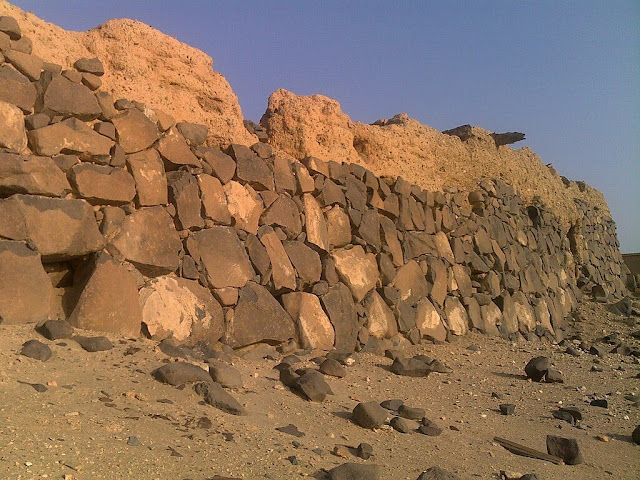
  In the desert of northern Peru is an ancient earthen wall known as the Muralla La Cumbre. It was built near the capital city of Chan Chan, home to the Chimú people, who lived around the 9th-15th century.  In 1470, they were conquered by the Incas. The wall was constructed during the 13th and 14th centuries and spans across 6 miles.  Anthropologists believed it was meant to protect farmlands from invaders, especially since there are accounts of a long-lasting war between the Chimú and Incas in 1400. But new evidence suggests it was built to protect them from devastating floodwaters during El Niño - a climate fluctuation where winds along the equator are weaker, pushing warm water back east along the west coast of the Americas.  This causes the Pacific jet stream to move south and extend, bringing moisture with it. Gabriel Prieto, from the Department of Anthropology at the University of Florida, found layers of sediment on just one side of the wall, and that the lowe...

Science is Fun Fridays!

Image
  In 79 AD, Mount Vesuvius erupted, burying the towns of Pompeii and Herculaneum.   A cloud of scorching ash buried a young man in Herculaneum.  As the ash cooled, it turned some of his brain to glass.  Above, we're looking at some of his nerve cells. Pier Pablo Petrone is a biologist and forensic anthropologist at the University of Naples Federico II in Italy.  He has found brain samples before, but says they were of a soaplike substance or were mummified. But in this case, the brain turned to glass as it was heated, liquefied and cooled.  This process is called vitrification.  Petrone and colleagues used electron microscopy to study the remains - they found layers of tissue wrapped around tendrils in the brain tissue and concluded it was myelin, a fatty substance that helps carry signals along nerve fibers. "This is the first ever discovery of ancient human brain remains vitrified by hot ash during a volcanic eruption." Science News