Posts

Showing posts with the label NASA

International Asteroid Day

Image
  Eyes on Asteroids This day marks the anniversary of the Tunguska event in Siberia, 1908. It was the largest impact in recorded history, but as we touched on before, it never actually hit the ground.  It exploded in the air, sending a shockwave that flattened millions of trees across 830 square miles. The largest confirmed impact crater is the Vredefort in South Africa, formed about 2 billion years ago. The Chicxulub crater is buried underneath the Yucatan Peninsula, from 66 million years ago.

Science is Fun Fridays!

Image
  The Orion spacecraft, on its way to the moon and back. NASA has a tracking  site , and this is a current screenshot. They also have a live mission broadcast. They just got their wake up call, "get some science done!" Operations

Science is Fun Fridays!

Image
 The Artemis II rocket has made its way to the launch pad at Kennedy Center. The trek takes about 12 hours, as a slow and careful transporter carries the rocket approximately 4 miles from the Vehicle Assembly Building. The window for launch is expected April 1, so in this meantime they will be running integrated testing and final preparations. The astronauts - Reid Wiseman, Victor Glover, Christina Koch, and Jeremy Hansen - have been placed into a 14 day quarantine.  Their mission will be run approximately 10 days as they go around the moon and back. The purpose is to test systems, such as the SLS, with a human crew before moving into the next phases.   Artemis III will test rendezvous and docking capabilities of the Orion craft. Artemis IV will be a lunar landing. The Artemis V crew will begin building a permanent Moon base.

Science is Fun Fridays!

Image
  This is Arrokoth, located in the Kuiper Belt, as photographed by New Horizons. Launched in 2006, its primary mission was to collect data on Pluto and its moons.  This was completed in 2015, and then NASA sent the spacecraft towards the object above. Arriving in 2019, it was confirmed to be a cold object, not "because it's far from the Sun; it's dynamically cold.  Its orbit has been pretty much the same for the entire history of the Solar System," according to New Horizons mission scientist, Carey Lisse. Cold objects make up about 1/3 of the Kuiper belt, suggesting they haven't been much disturbed by the giant planets. Scientists learned that the clumping wasn't violent either, they appear to be just touching each other, "like they are kissing, or if they were spacecraft they would be docking," says co-investigator William McKinnon. Further study of such objects can tell us a lot about the formation of the Solar System. New Horizons  is still operat...

Science is Fun Fridays!

Image
 The NASA crew is one step closer to the Artemis II mission - originally expected last year, now planned for April 2026. In early June, the lunar science team ran a mission simulation for the first time in the newly completed Science Evaluation Room in Houston. This room will support the mission's main flight control room, equipped for rapid data interpretation, collaborative analysis, real-time decision making, and seamless coordination between the science and operations teams. Through Artemis, NASA will send astronauts to explore the Moon for scientific discovery, economic benefits, and build the foundation for the first crew to Mars.  The first launch will be a trip around the Moon, to confirm all of the spacecraft's systems are operating as designed in the actual environment of deep space.

Science is Fun Fridays!

Image
  Monday, April 8th! Here  you can enter your location for viewing and time. On my end, we'll get 35.7% coverage at 11:19am. NASA will have a live broadcast. Remember your safety precautions - and if you're in an area of totality, I see a lot of headlines about preparing for the crowds of visitors.  Texas has even deployed their National Guard, "a proactive step towards ensuring a successful and incident-free event."

Webb Wednesday

Image
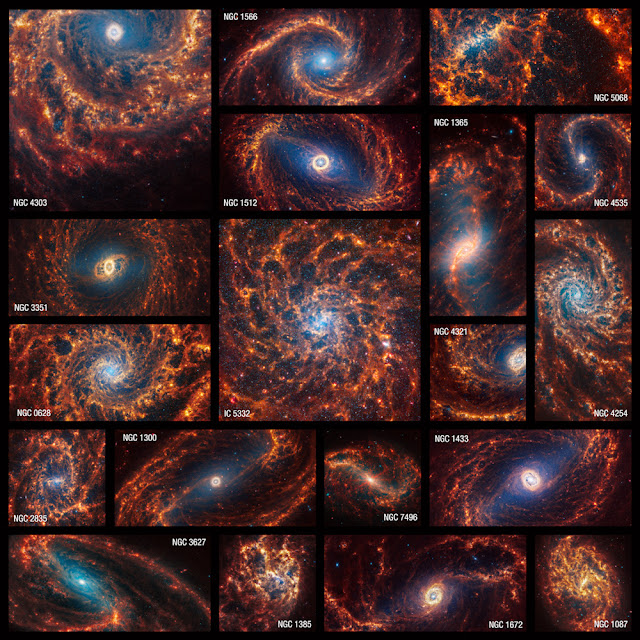
  The James Webb Telescope observed 19 nearby spiral galaxies in near- and mid-infrared light. Webb's NIRCam (Near-infrared) captured millions of stars in these images, which sparkle in blue tones.  The MIRI (mid-infrared instrument) highlights the glowing dust, and the stars that aren't fully formed, still encased in gas, as the red dots. This is part of an ongoing project with the PHANGS program (Physics at High Angular resolution in Nearby GalaxieS).  The team also has data from Hubble, the Very Large Telescope's Multi Unit Spectroscopic Explorer, and the Atacama Large Millimeter/submillimeter Array, which includes observations in ultraviolet, visible, and radio light. Here we have NGC 628 split diagonally with Webb imagery at top left and Hubble at bottom right. This galaxy is 32 million lightyears away, in the constellation Pisces. Article

Science is Fun Fridays!

Image
  The Artemis II crew: Mission Specialist Christina Hammock Koch, Commander Reid Wiseman (seated), Pilot Victor Glover, and Mission Specialist from the Canadian Space Agency, Jeremy Hansen. "This mission paves the way for the expansion of human deep space exploration and presents new opportunities for scientific discoveries, commercial, industry and academic partnerships and the Artemis Generation," said Director Vanessa Wyche. Moon to Mars Strategy and Objectives Development The first stage will be a test flight, sending the astronauts around the Moon and back home. The core is being built at NASA's Michoud Assembly Facility with the help of Boeing and Aerojet Rocketdyne.  Once the engines are installed, it will produce more than 2 million pounds of thrust at launch. The launch is scheduled for late 2024.

Artemis Update

Image
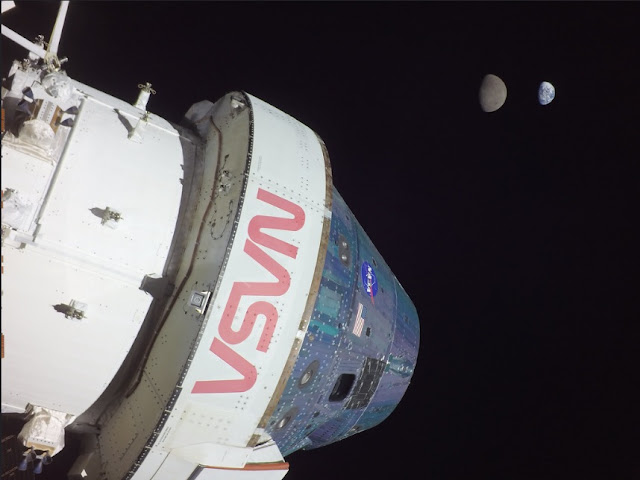
  Day 13, the halfway point for Orion where it will continue its retrograde orbit before returning home. Orion has been performing so well, managers are considering additional test objectives to "further characterize the the spacecraft's thermal environment and propulsion system to reduce risk before flying future missions with crew." Here's a shot from Day 6, when Orion passed by the Moon. NASA

To the Moon, Artemis!

Image
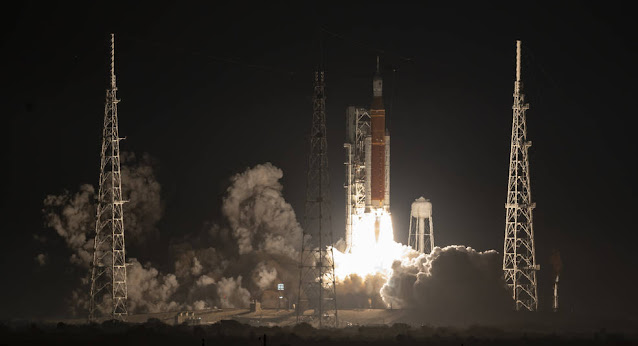
  NASA's Space Launch System rocket carries the Orion spacecraft. This first mission is unmanned, with an itinerary to travel 40,000 miles beyond the Moon and return to Earth in about 25 days. Artemis I is the first integrated flight test of the agency's deep space exploration systems, "helping us prepare for human exploration on the Moon and, ultimately, Mars," said NASA Administrator Bill Nelson.   Astronauts are expected to fly in the Artemis II mission in 2023. Mission I Mission II

Science is Found Friday!

Image
  A documentary crew looking for wartime wreckage came across something else entirely off the coast of Florida. You may notice the thermal tiles, as they did, which led them to contact NASA. And you may have guessed it's from Challenger, which exploded in 1986.  Before this, only 47% of the vehicle debris has been recovered, and this is one of the biggest pieces found to date. "This discovery gives us an opportunity to pause once again, to uplift the legacies of the seven pioneers we lost, and to reflect on how this tragedy changed us," NASA Administrator Bill Nelson said in a statement. "Today, as we turn our sights again upward toward the Moon and Mars, we see that the same love of exploration that drove the Challenger crew is still inspiring the astronauts of today's Artemis Generation," said Kennedy Space Center Director Janet Petro. The Artemis Mission is tentatively scheduled to launch on November 16th, weather permitting. The goal is to study the luna...

Double Asteroid Redirection Test

Image
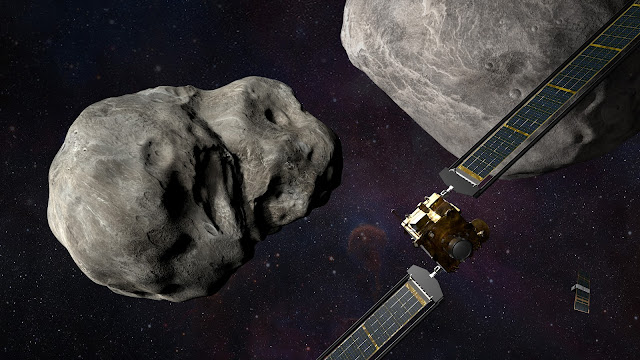
  Yesterday, after 10 months of flying in space, DART collided with the asteroid, Dimorphos. It was a test of a planetary defense strategy, and while the impact was a success, the team needs to observe the asteroid to confirm its orbit around Didymos has been altered as a result.  They expect it to be shortened by 1%, or 10 minutes. "Beyond the truly exciting success of the technology demonstration, capabilities based on DART could one day be used to change the course of an asteroid to protect our planet and preserve life on Earth as we know it," says Director of the Applied Physics Laboratory, Ralph Semmel. NASA (Also, be sure to search "nasa dart" on Google for a little fun).

James Webb Telescope

Image
  The first fully operational image released by NASA from the James Webb Telescope. This is the SMACS 0723 galaxy cluster.  The combined mass of the cluster acts as a gravitational lens, magnifying distant galaxies while the gravitational field bends light rays from more distant galaxies behind it. Here  NASA is posting the images one by one, and this is the most recent. Carina Nebula Captured in infrared light, this image reveals "previously invisible areas of star birth." Part of Webb's science operations will be to study the gas and dust involved in star formation. Tomorrow will be the NASA Q&A.

Return to Earth

Image
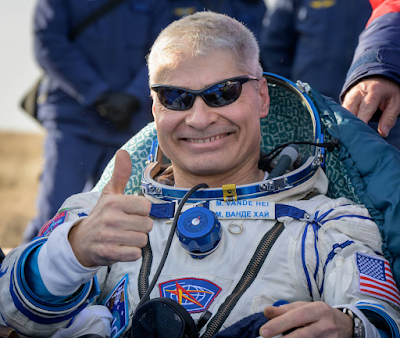
  Astronaut Mark Vande Hei returned home yesterday after a record-breaking 355 days in single spaceflight. Despite conflict here on Earth, he was able to hitch a ride with Russian cosmonaut, Pyotr Dubrov (355 days) and Anton Shkaplerov (176 days). Vande Hei's mission will provide researchers an opportunity to observe the effects of long-duration spaceflight on humans as NASA plans for the Artemis program to return to the Moon and prepare for Mars exploration. He completed about 5,680 orbits and traveled more than 150 million miles, or roughly 312 trips to the moon and back.  While on board, he conducted experiments from plant research to physical science studies.

James Webb Telescope

Image
 Launch day has been postponed (again) due to adverse weather in Kourou, French Guiana. It is now set for December 25, but since I won't be here posting that day, I wanted to set a spot for us. James Webb is the successor to Hubble, with missions to find the first galaxies formed in the universe and to peer through dusty clouds to see stars forming planetary systems. Ultraviolet and visible light emitted by the very first luminous objects has been stretched, or "redshifted" by the continual expansion of the universe and arrives today as infrared light.  Webb is designed to see this light with unprecedented resolution and sensitivity. Using a technique called transmission spectroscopy, Webb will examine starlight filtered through planetary atmospheres to learn about their chemical compositions.  It will observe exoplanets to determine if and where signatures of habitability may be present. After launch, Webb will travel about a million miles from Earth and undergo six mont...

Science is Fun Fridays!

Image
  More space news! Tomorrow, the first ever Lucy Mission launches towards the Trojan Asteroids. They are thought to be remnants of the primordial material that formed the outer planets.  They orbit the Sun in two loose groups, one ahead of Jupiter and one behind.  They are stabilized by the Sun and Jupiter in a gravitational balancing act. The mission takes its name from the fossilized human ancestor which gave us insight into humanity's evolution.  In the same sense, they hope to gain insight into our solar system's evolution. This is expected to be a 12 year journey to eight asteroids.  The first will be 52246 Donaldjohanson, named for the anthropologist discoverer of Lucy, in April 2025. The dark red P and D type Trojans resemble those found in the Kuiper Belt.  The C types are found mostly in the outer parts of the Main Belt.  All Trojans are thought to be abundant in dark carbon compounds. NASA

NASA Live Stream

Image
  Following up on yesterday's thread, I wanted to focus on the press brief today.  I set a reminder for myself but I haven't really stopped thinking about it. Feel free to add any commentary throughout the day! Thomas Zurbuchen - associate administrator for science, NASA headquarters Jennifer Trosper - Perseverance project manager, JPL Oliver Toupet - Perseverance enhanced navigation team lead, JPL Ken Farley - Perseverance project scientist, Caltech Vivian Sun - Perseverance science campaign co-lead, JPL Mission Page

NASA News

Image
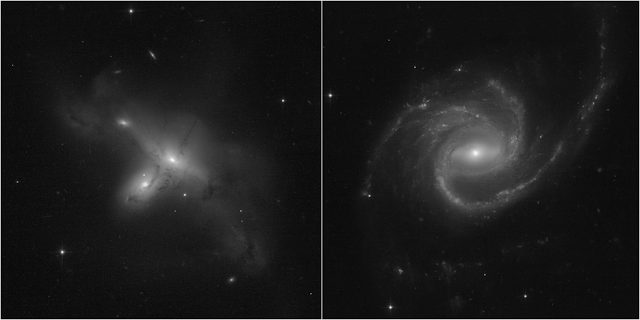
On  Asteroid Day  it was mentioned that the Hubble Telescope had been reported down. As of yesterday, it is back in action! These images confirm Hubble's return to its mission, capturing galaxy MADORE2115-273 on the left, and ARP-MADORE0002-503, an unusual spiral galaxy with three arms. On June 13, Hubble's payload computer, which controls and coordinates the science instruments onboard, stopped working.  When the main computer failed to receive a signal, it shut down into safe mode. One thing to remember is the Hubble was built in the 1980's, so when the team on the ground had to figure out what was wrong with it, they had to look back on previous technology and the knowledge collected from the staff over the years.  Retired alumni did come in to assist, including those who had helped build it. "That's one of the benefits of a program that's been running for over 30 years: the incredible amount of experience and expertise," says Nzinga Tull, the Hubble Sy...

Science is Fun Fridays!!

Image
 Hello Vousers! I'm off at noon today so this will be an open thread. Here's a night sky image from Perseverance . There's also a really cool panoramic picture  Here In 8 days (sols, as they're called on Mars), the rover has already taken 5,614 images! And  here  you can listen to some audio it has picked up. Have a wonderful weekend, everyone!!

Science is Fun Fridays!

Image
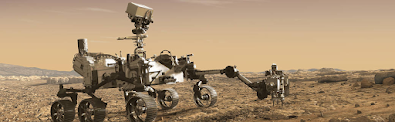
Following up on yesterday's space post and the landing of the Mars rover, we're going to focus on Perseverance today. This is the first image sent back from its landing location in the Jezero Crater. Interactive Map Main Job: To seek signs of ancient life and collect samples of rock and soil. 3D Rover Perseverance carries seven instruments to conduct "unprecedented science." Mastcam-Z for panoramic and stereoscopic imaging. SuperCam can provide imaging, chemical composition analysis, and mineralogy from a distance. Planetary Instrument for X-ray Lithoscopy (PIXL) which can map the fine-scale elemental composition of the Martian surface materials. Scanning Habitable Environments with Raman and Luminescence for Organics and Chemicals (SHERLOC) which uses UV to map mineralogy and organic compounds. Mars Oxygen In-Situ Resource Utilization Experiment (MOXIE), a technology demonstration that will produce oxygen from Martian atmospheric carbon dioxide. Mars Environmental D...