Posts

Showing posts with the label Water

Science is Fun Fridays!

Image
  South of town is a historic resort, with natural hot springs that were nationally acclaimed by President Ulysses S. Grant when he visited in 1879. Steamboat Hot Springs. The area is a small volcanic field of rhyolitic lava domes including steam vents and fumaroles. The name is attributed to Mark Twain, who is quoted as saying, "Behold! A Steamboat in the desert!" The waters are a combination of sulfate minerals not found anywhere else in the US. "Geologically, the springs are among the most interesting in the world, for they demonstrate in a striking way how mineral veins and deposits are formed," noted state engineer, Alfred Merritt Smith, in 1935. We stopped in for a quick soak this week, and it felt amazing.  The added aromatherapy certainly helped - a signature blend of lavender, orange, and cedarwood.  So relaxing, calming, and nourishing. The Water There's a nearby geothermal plant as well, producing over 24 Megawatts of electricity, enough to supply 24,...

Science is Fun Fridays!

Image
  China's "Great Green Wall" initiative is an effort to slow land degradation and climate change by planting trees and restoring grasslands. From 2001 to 2020, "they have actively restored thriving ecosystems, especially in the Loess Plateau.  This has also reactivated the water cycle." Evaporation removes water from surfaces and soils, while transpiration removes water that plants have absorbed from the soil.  Together, this is called evapotranspiration, and this fluctuates with plant cover, as well as water availability and solar energy. Increasing evapotranspiration, in turn, increases precipitation. These changes led to less fresh water in the eastern monsoon region, and increased water availability in the Tibetan Plateau. China's restoration accounts for 25% of the global net increase in leaf area from 2000-2017.

Science is Fun Fridays!

Image
 The world's oldest pool of water has been found deep within the Kidd Creek Mine of Ontario, Canada. Geologist/Professor Barbara Sherwood Lollar led a team into the rock, 1.8 miles below the surface. She even tasted the water, explaining that she was looking for a salty taste.  Saltier tends to be older.  She confirmed it is much saltier than seawater.  Bitter too. The team found traces that indicated life had once been present. "By looking at the sulphate in water, we were able to see a fingerprint...the signal we are seeing in the fluids has to have been produced by microbiology - and most importantly has to have been produced over a very long time scale." Without light, the microbes survived using substrates produced from radiation. As long as the water and rock are in contact, the reaction that creates the sulfate will continue to occur naturally and persist potentially billions of years.

Rain Day

Image
(Not My Shot) The last two evenings have brought storm clouds, thunder, and rain. This is mostly good, we definitely need the water, but the flash flooding created some issues. Rain Day started in the late 1800's, when a pharmacist in Waynesburg, PA noted that it always seemed to rain on July 29th.  He started keeping a record, and after he passed, his brother continued.  A local newsman shared the story with other newspapers, and it became tradition to call into Waynesburg to see if it's raining today.  

Science is Fun Fridays!

Image
  The Grand Coulee Dam on the Columbia River. It is the largest hydropower producer in the United States, generating enough electricity to power much of the Pacific Northwest. It is a gravity dam, which resists the force of water pushing against it through sheer mass.  The weight of the dam, acting downwards, counteracts the horizontal force of water. The dam creates a reservoir on the river, named Lake Roosevelt, for FDR was president during construction. From May through September, a laser show is projected onto the dam, called "One River, Many Voices."  It started in 1989 and is one of the largest light shows in the US.

Confluence

Image
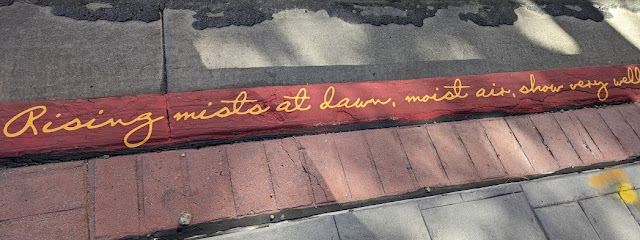
  Artist and stream scientist, Todd Gilens, has created a mile long poem along the sidewalks of downtown Reno.  He's used a unique font, made from the handwriting of Claude Dukes, Federal Water Master for the Truckee and Carson rivers from 1959 to 1984. His research focuses on the dynamics of water in mountain ecosystems and changing climates.  The poem is a celebration of water and its journey, making connections between people, resources, and their surrounding landscapes. "...to connect in a public place, and the public place was the urban curb like the pathway where water flows through cities." His Site Excerpt

World Water Day

Image
 Held on this day since 1993, we celebrate water and raise awareness of the 2 billion people living without access to safe water for drinking and/or sanitation. This year's focus is on sustainably managing groundwater. "As climate change gets worse, groundwater will become more and more critical." Making the Invisible Visible The Weather Channel is bringing attention to the importance of our watersheds. Flood, drought and water pollution are crises that "are merely symptoms of a broader syndrome - watersheds in poor health." These are essentially our drainage basins.  Here, it's the Truckee River, and all the mountain streams that flow into it.  The Parks Foundation taught me why undesignated trails contribute to water pollution, in paving a way, so to speak, for water in an area that hasn't been cleared of other debris. A healthy watershed needs an intact ecosystem, such as forests, wetlands, grasslands and streams which help regulate the quantity, qual...

Animal Life - Water Bowl

Image
Once upon a time on the Animal Life channel I posted this video I came across: *Swimming bees were rescued* And now, another video has come to my attention - Ahmet Selki lives in Turkey and leaves out a water bowl for the animals every day.  One day he decided to put a camera inside. "I hope that all of us will always remember that we are responsible for the animals.  They don't have a chance to find a clean river in the city, or a lake, or any other natural water source.  So it is our duty to provide fresh water, both during summer and other seasons."