Posts

Showing posts with the label Engineering

Auto Shop - Cadillac Formula 1

Image
  One of the commercials I noticed during the Super Bowl was announcing Cadillac's entrance into the world of F1 racing. This will be the first true American team, but there have been others involved. Ford became an official engine supplier in 1967, beginning a partnership with Cosworth, a British automotive engineering company.  They introduced the Ford-Cosworth DVF engine, which won on its debut.  Ford has had 176 Grand Prix wins. In 2014, George Haas started the first American-licensed team, being the first American constructor to submit an F1 entry.  Their cars are designed by Italian manufacturer, Dallara. The 2026 season begins in March, with a double header race in Australia. Drivers: Sergio Perez, from Mexico, has won six races, previously with Red Bull. Valtteri Bottas, from Finland, has won ten races, previously with Mercedes.   Team

Science is Fun Fridays!

Image
 Earlier this week we touched on the anthropology of disability, which falls under the Cultural arm. As a whole, the study is of cultural variation among humans.  It views disability as a culturally constructed experience shaped by social norms, environments, and power. Scandinavia is one of the best societies, in this respect, with high-level accessibility and per capita funding for physical impairments, investing heavily in infrastructure and social support systems that prioritize independence. In the United States, Minneapolis ranks as a top city for disability care and accessibility. Disability infrastructure is more than ramps instead of stairs, it's about public transportation, navigation, bicycling/walking as well as inclusion within regional parks and other recreational activities. From what I can tell, there are only two locations that allow wheelchair access directly to the Truckee River here in town. Published in 1963, Designing for the Disabled, was the first to pr...

Science is Fun Fridays!

Image
  Boston University is a major hub for this rapidly growing field in biomedical engineering. Faculty there build molecular and photonic tools to study the brain; investigate the quantitative neurophysiology underlying brain and nervous system function; develop computational models that guide our understanding of brain function; work to understand and treat neurological disorders; and advance methods by which we can help repair the brain and restore neurological function. The Neurophotonics Center is driven by advances in optical methods, allowing for visualization of intracellular organelles and protein assemblies as well as noninvasive macroscopic investigation of cortical activity. Director David Boas, PhD, runs the Bio Optical and Acoustic Spectroscopy Lab. "Our technologies are used for measuring brain function and physiology on microscopic to macroscopic length scales and are applied in species ranging from mice to humans." The most prominent new technology is wearable f...

Auto Shop - Quadricycle

Image
 On this day in 1896, Henry Ford test-drove the first automobile he ever designed. He was working as chief engineer at the main plant of the Edison Illuminating Company when he started on the Quadricycle - a horseless carriage with a gas powered engine. Ford followed the American Machinist  magazine, and saw when Charles King built his own vehicle (out of wood) with a four-cylinder engine, which could travel up to five miles per hour.  Thus Ford was inspired to create something lighter and faster. He enlisted the help of King, as well as others, and used a light metal frame with 4 bicycle wheels, along with a two-cylinder, four-horsepower engine.  The quadricycle had two driving speeds, no reverse, no brakes, rudimentary steering, and a doorbell for a horn. Ford's chief assistant, James Bishop, bicycled ahead of the new craft to alert carriages and pedestrians on Detroit's Grand River Avenue.  Reaching 20mph, he had achieved his goal.

Science is Fun Fridays!

Image
   These are biobased spores, made of plants and filled with recycled oils that could be used for self-healing roads.   Experiments have shown that when asphalt cracks, this material can help reverse the process. Bitumen is the mixture of hydrocarbons obtained as a residue of petroleum distillation that is used for road surfacing.  By eliminating a need to maintain this over and over again, we'd not only see reduced environmental impact but also reduced cost and less travel disruption. Dr. Jose Norambuena-Contreras of Swansea University is a leading expert in self-healing asphalt. "This multidisciplinary research integrates Material Science, Civil Engineering, and Chemical Engineering." He won the RILEM Robert L'Hermite Medal in 2024 for "exceptional scientific contribution to the field of construction materials and structure."  This is awarded to researchers under 40 by the International Union of Laboratories and Experts in Construction Materials, Systems, ...

Hump Day History

Image
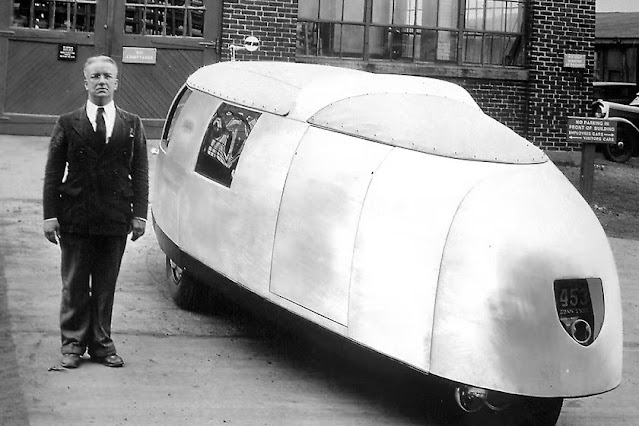
  On this day in 1933, architect/engineer Buckminster Fuller, unveiled his Dymaxion Car #1. A made-up word combining dynamic, maximum and ion, it was the first three-wheeled, multi-directional vehicle.  Fuller lived his life with the intent of experimenting and contributing to "changing the world and benefiting all humanity." The sketches began in 1927 and included wings that could inflate.  Production began in early 1933, using a steel chassis and a body made of ash wood, covered with an aluminum skin and topped with a painted canvas roof.  It was designed to reach a speed of 120mph and average 28 miles per gallon. Fuller sold the car to Gulf Oil, and it was put on display at the Century of Progress expo in Chicago. However, in October professional driver Francis Turner was killed when the Dymaxion turned over during a demonstration.  The vehicle was cleared, but investors were concerned. Fuller also created a Dymaxion house, which used tension suspension from ...

This Day in History

Image
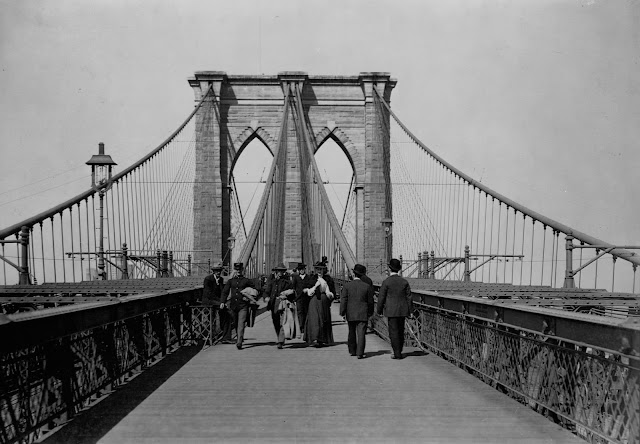
  On this day in 1883, after 14 years of construction, the Brooklyn Bridge was opened to the public. Designed by John Roebling, it was the largest suspension bridge built at the time. He was born in Germany in 1806, and was a pioneer in the design of steel suspension bridges.  After immigrating to Pennsylvania at the age of 25, he eventually found work as a civil engineer and established a successful wire-cable factory. His major technological breakthrough was a web truss added to either side of the roadway which greatly stabilized the structure.  Before Brooklyn, he bridged the Niagara Gorge and the Ohio River. Roebling was not able to see his work completed.  Before construction began, he was taking a few final compass readings of the East River when a boat smashed his toes.  Three weeks later he died of tetanus.  His son Washington had assisted in the design and took over as Chief Engineer. He was among more than 100 workers who suffered from compression...

Science is Fun Fridays!

Image
 The world's tallest indoor waterfall is an engineering marvel located inside the Jewel Changi Airport in Singapore. The HSBC Rain Vortex stretches over seven floors, and to create the circular flow, there are structural features built into the exterior of the building. A network of pipes channel water to the ring in the center, and the oculus distributes water down evenly. The black ring there is the reflection pool, where the water continues downward into an acrylic column called the Water Skin. The water is then cycled back to the Vortex.  Rainwater is also collected, and when the water tanks are full, it is diverted for irrigation.  The water is constantly tested to make sure it is safe and clean. Surrounding the Vortex is the Shiseido Forest Valley, which includes more than 900 trees and palms, and about 60,000 shrubs from around the world.  There are hiking trails which can take you to Cataract Falls and Canopy Park. Singapore is known as the "City in a Garden"...