Posts

Showing posts with the label Paleontology

Science is Fun Fridays!

Image
  Pterosaurs have incredibly lightweight skeletons, so finding one intact is pretty rare. In the Solnhofen Limestones in Germany, paleontologists came across a perfectly preserved hatchling.  And it is tiny, with a wingspan of less than 20 centimeters. "The odds of preserving one are already slim, and finding a fossil that tells you how the animal died is even rarer," reports lead author, Rab Smyth, from the University of Leicester Centre for Paleobiology. The fractures suggest a powerful twisting force, such as a severe storm, that caused catastrophic injuries. It should be noted that several young pterosaur fossils have been found in this area, and now scientists understand why - adults would likely have survived the storm. Here they explain the conditions:

Science is Fun Fridays!

Image
 Nilpena Ediacara National Park in Australia is home to the oldest fossils in the world. Millions of years ago, the Southern outback was part of the coastline, and a shallow seabed teeming with some of the first lifeforms on the planet - ediacaran biota.  These were mostly tubular and frond-shaped, immobile. "There are around 60 places in the world that have Ediacara fossils...  Elsewhere, you might be looking at a few individual specimens, but here, we're pulling out whole sections of the sea floor and piecing it back together," reports Kim Geue, the ranger in charge. Whole ecosystems are being revealed, containing tens of thousands of preserved specimens. The Australian government is pushing to have the surrounding Flinders Ranges designated a UNESCO World Heritage Site.

Science is Fun Fridays!

Image
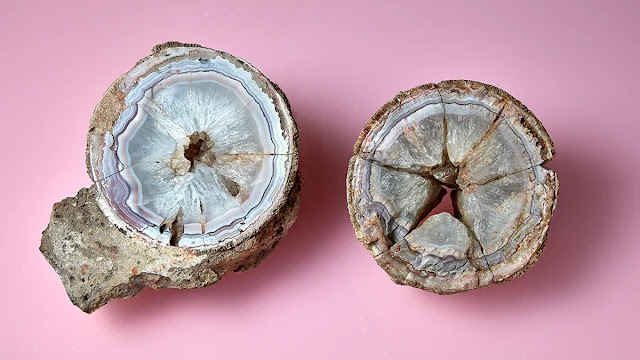
  Agate is a rock formation, often within volcanic and metamorphic rocks.  Consisting of chalcedony and quartz, they can come in a wide variety of colors. The above was registered to the Natural History Museum's Mineralogy Collection 175 years ago.  The particular pink and white interior caught the eye of Robin Hansen, a mineral curator.  The specimen was taken to a mineral show in France, where Hansen saw an agatised dinosaur egg that had many similarities... The piece was picked up in India, and has features that are the same as Titanosaur eggs, the most common dinosaurs in the area 60 million years ago. Hansen and the dinosaur experts now involved believe volcanic activity led to the egg being encased in volcanic rock.  The internal structures would have internally decomposed, and the silica-rich water would have made its way into the egg cavity, creating the banded agate specimen. Or, "eggate." IFL Science

Science is Fun Fridays!

Image
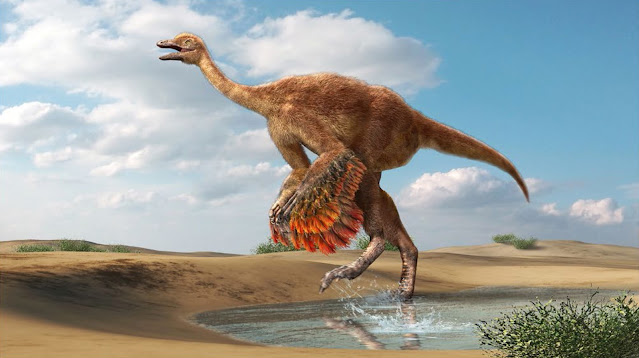
  Here's a mouthful: ornithomimosaurians, or therapod dinosaurs which bear a resemblance to the modern-day ostrich.  The specimens found in Mississippi, however, reveal the largest known to have existed, clocking in over 1700 pounds. Researchers were able to determine there are actually two taxa of different body sizes, and that they cohabited. They concluded that not only does this provide "key information on the diversity and distribution of North American ornithomimosaurs from the Appalachian landmass, but it also suggest broader evidence of multiple cohabiting species of ornithomimosaurian dinosaurs in Late Cretaceous ecosystems of Laurasia."  IFL Science

Science is Fun Fridays!

Image
Hubby and I were watching "Dino Hunt" before bed last night, and a lot was taking place in Dinosaur Provincial Park in Alberta.  I wanted to share a few of those findings. #FossilFriday! This is Borealopelta,  a relative of the Ankylosaur.  It is so well preserved that skin and soft tissues remain, and scientists have been able to determine its color based on lingering pigments. Scientists believe this animal drowned somehow and its body taken out to sea, where it floated belly up until gases released, causing the dinosaur to sink.  It hit the ocean floor hard enough to leave a small crater, and was then covered by fine sediment that encased it for millions of years. Artist Representation Royal Tyrell Musem of Paleontology In a bone bed along Milk River, a new species of Ceratops was found and named for the woman who first found the spot - Wendiceratops.  They knew when they found the horn pattern along the frill that they had somethin...