Posts

Showing posts with the label Google Doodle

Science is Fun Fridays!

Image
  Today's Google Doodle celebrates the 140th birthday of Casimir Funk, a biochemist who was among the first to introduce the concept of vitamins. He began work in organic chemistry at various research institutions across Europe.  He became more and more interested in the effects of food ingredients on certain illnesses such as scurvy, pellagra, and rickets.  He read that people who ate brown rice were less vulnerable to a condition called beri-beri. In 1911, he began experimenting and was able to isolate the substance responsible.  He formed small, ingestible crystals that he called vitamines - vita (life) amine (chemical compound containing an amino group).  At the time, he thought he was working with thiamine (B1) but it was later known to be niacin (B3). He continued his work discovering different vitamins and determining which foods they could be found in.  He published his findings, Die Vitamine, in 1914. He worked as a consultant for the US Vitamin Co...
Agnès Varda

Image
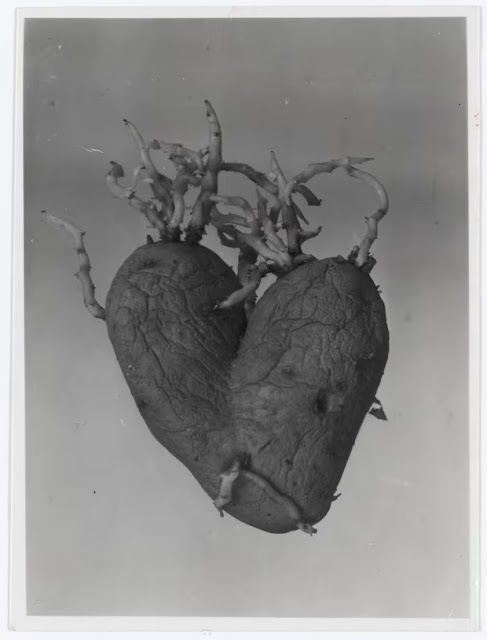
  Today, Google Doodle wants us to know about photographer and filmmaker, Agnes Varda. Above is "Heart Potato" from 1953. Her black and white photography was the subject of an exhibition in Arles, France this year.  She had moved to Paris in the late 40's to study photography, and her daughter says "the seeds of her groundbreaking cinema lie in her earliest still images." "Reflections on the Quay," 1950. "Nude," 1954. "Nus dans les ruines," 1954. In China, 1957. "Enfant," 1957. Her first film, La Pointe Court  was released in 1955 and is considered a forerunner of the French New Wave. Varda became the first woman to win the Honorary Palme d'Or at the 2015 Cannes Film Festival. She passed away in 2019 at age 90.

Art Class - Magdalena

Image
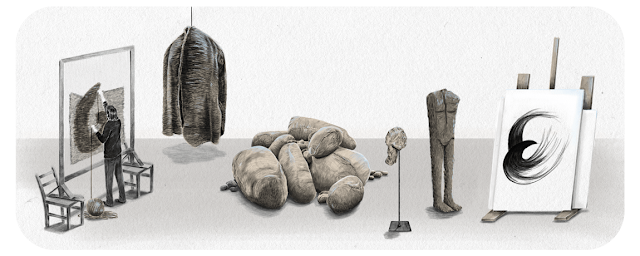
  Today's Google Doodle is to honor the 93rd birthday of Magdalena Abakanowicz, a Polish sculptor and fiber artist. Born in 1930, her childhood was disrupted by World War II.  She graduated from the Academy of Fine Arts in Warsaw in 1954. She initially painted gouaches on canvas, such as From the Birds Cycle, 1957. Fish, 1955/56. In the 1960's she began experimenting with soft sculptures, turning fabric into three-dimensional forms, which were called Abakans.  She won top prize at the Sao Paulo International Art Biennial in 1965. Backs, started in 1967. Abakan Red, 1969. From the exhibit,  Every Tangle of Thread and Rope. Her work, Agora,  is featured in Chicago Grant Park, and is considered her most important statement about humanity, inspired by "The Crowd" sociological phenomenon - that crowds act as a whole and individuals lose their individuality within. In Milwaukee, The Group of Five.

Game On

Image
  Today's Google Doodle celebrates Jerry Lawson, on what would have been his 82nd birthday. He was an electronic engineer and is the father of the commercial video game cartridge. A year before Atari came out in 1977, the Fairchild Channel F was released. Hockey and Tennis games were integrated, and 3 cartridges were available - which included Blackjack, a shooting gallery, and Tic-Tac-Toe.  By 1981, they had 26 "videocarts," as they were called. Google  has some games to play. I didn't have my own video game console until N64, but I had played Atari and OG Nintendo.  From the Mario games to Mike Tyson's Punch Out.  Classics. We don't play much now, and we have Playstation instead of Nintendo.  Long gone are the days of the cartridge though. But we'll never forget.

American Indian Heritage Month

Image
  Google is kicking off the month with a little history on North American Stickball. Invented as a ceremonial sport by native tribes - such as Cherokee, Chickasaw, Choctaw, Seminole, and Yuchi - it is one of the oldest team sports. Elder tribal leaders would organize games of Stickball to settle disputes without violence. There are a few versions of the origin story, but it always comes down to the land animals challenging the birds to a game.  Like the hare with the tortoise, they assume it will be easy, but they are defeated. To play, grab a stick!  The goal is to move the ball towards the other team's goalpost, scoring a point when hitting said goalpost.  You cannot touch the ball with your hands.  Various tribes continue to play the sport along with its ceremonial traditions. Modern day field lacrosse originated from Stickball. Alf Jacques, of the Onandaga Turtle Clan, has been making sticks for over 50 years, helping to preserve the culture.  He's also...

Music Tasting 29

Image
  "In honor of US Hispanic Heritage Month, today's animated video Doodle celebrates the life and legacy of American "Nuyorican" musician and internationally-renowned entertainer, Tito Puente." To this date, his best-selling track. Tito loved the Cha-Cha rhythm, and this song is one of his most famous pieces. He was heavily influenced by Big Band jazz, and this song combines the American and Latin traditions. For Latin Jazz though, this one's named as his most famous. "A song where you can fully appreciate the ability Tito Puente had playing the vibes."

This Day in History

Image
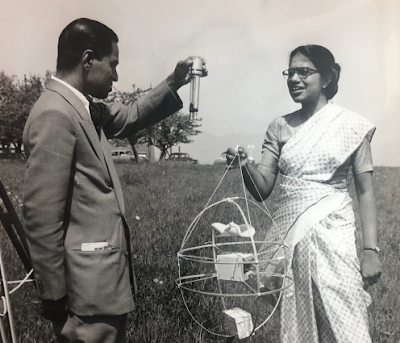
  Today's Google Doodle brings our attention to Anna Mani, Indian physicist and meteorologist. She would have been 104 today. She earned a Bachelor of Science with honors in Physics and Chemistry.  At the age of 22, she received a scholarship from the Indian Institute of Science.  Although she completed five research papers and a dissertation, they wouldn't give her a PhD without a Master's degree, so she obtained another scholarship to attend the Imperial College of London.  There she specialized in meteorological instruments, their calibration and standardization. In 1948, she returned to India and joined the Meteorological Department.  She wanted to make India self-sufficient by designing and manufacturing its own weather instruments.  She constructed rain gauges, hydrographs, thermographs, barographs, barometers, anemographs, etc.  She was most interested in solar energy and set up a network of stations to measure solar radiation.   She r...

Art Class - Google Doodle Competition

Image
  This year's winner: Not Alone, by high school student, Sophie Araque-Liu. The theme setting out was, "I care for myself by..." "I care for myself by accepting others' care for me.  Often, I struggle to shoulder a burden on my own, and forget that I have so many people, like my mom, who care about me and want to help me.  Opening up and letting others support me not only relieves my stress - it also lets me tackle things I could never do on my own." For this, Sophie will receive a $30,000 scholarship and a $50,000 technology award for her school. Judges included the 2021 Teacher of the Year, Juliana Urtubey, and actress Selena Gomez.  First they select state/territory winners, and then they break down into age groups. Here are some of the finalists. K-3: Dreaming of a Bright Future 4-5: Family 6-7: My Self Love 8-9: The Life-Cycle of Health And this one was the Nevada winner. Life Beyond Imagination

Hump Day History

Image
  Today, Google is making sure we're familiar with comedian Charlie Hill. Born on this day in 1951, he was a member of the Oneida Nation of Wisconsin, the first Native American to be a TV comedy stand up star.  He wrote for the series, Roseanne (1995) and Moesha (1996) , and he appeared on Night Shows with Johnny Carson, Jay Leno, and David Letterman. Here he is on the Richard Pryor Show in 1977. In 1999, he was the subject of a PBS documentary titled, On and Off the Res' with Charlie Hill. In 2005, he was part of the Winnipeg Comedy Festival. Charlie died of lymphoma in Oneida, December 2013. He was honored in 2010 for "his lifetime of promoting positive images of Native Peoples and bridging cultural differences through the healing power of humor." And that is something worth carrying on.

Hump Day History

Image
 Today's Google Doodle honors Johannes Gutenberg, on this 21st anniversary of the Gutenberg Museum in Mainz, Germany - Johannes' hometown. He is famed for inventing the moveable type printing press in 1439.  This process replaced handwritten manuscripts and wooden block printing with a moveable metal type, adjustable molds, and oil-based inks. He printed a book on Latin grammar in 1451, but his biggest hit would be the Bible in 1455. By the 16th century, his press was used in more than 200 cities around Europe, with more than 200 million books produced.   Project Gutenberg  is named in his honor, the oldest digitized library. The museum has two of the original Gutenberg Bibles.  There is a reconstruction of his workshop, with demonstrations of how printing was done.  The museum also includes histories of paper and writing, newspapers and magazines, bookplates, graphic art and posters. Cinet Museum Pass

Hump Day History

Image
  Today's Google Doodle marks the 142nd birthday of Dr. Wu Lien-teh, a Chinese-Malaysian epidemiologist who invented the surgical face mask.   He was appointed to investigate the Manchurian Plague of 1910, and when he found that it was spread through respiratory transmission, he developed the protection we are still using today. In asking people to wear this new mask and restrict their travel, the disease was under control within four months. And here we are, entering the second year of Coronavirus... Wu was the first student of Chinese descent to graduate from Cambridge University. In 1935, he became the first Malaysian, and first person of Chinese descent, to be nominated for the Nobel Prize in Medicine. "A devoted advocate and practitioner of medical advancement, Wu's efforts not only changed public health in China but that of the entire world." USA Today

Hump Day History

Image
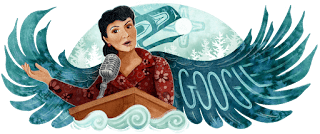
  Google tells me we should celebrate Elizabeth Peratrovich today. Born July 4, 1911 in Petersburg, Alaska - she died December 1, 1958. In 1988, the Alaska State Legislature designated February 16 as Elizabeth Peratrovich Day. Elizabeth was a civil rights activist, instrumental in the 1945 passage of the first anti-discrimination law in Alaska, and the United States. Elizabeth was born during a time of extreme segregation, and as a member of the Indigenous Tlingit tribe, she faced racism constantly. It was on this day in 1941 that she encountered a sign which read, "No Natives Allowed."  She and her husband then wrote a letter to the governor and gained support for their mission. They moved to Juneau for better access to lawmakers, but they were denied over and over when looking for homes.  Elizabeth was only more motivated now.  The bill failed in 1941, but when it came up again in 1945, she gave a speech on the floor of the Alaskan Senate and was met with thunderou...

Music Tasting - Mariachi

Image
 According to Google, we should celebrate Mariachi today. The song is Cielito Lindo. Mariachi is a genre of Mexican music that dates back to the 18th century, having evolved over the years in the western countryside.  On November 22, 2011 UNESCO included Mariachi on its Representative List of the Intangible Cultural Heritage of Humanity. I asked a friend of mine and she said Vicente Fernandez is her favorite singer. The "charro" outfits associated with Mariachi originate from the more rural settings of salon orchestras in the late 19th century, from which modern Mariachi stems. Considered "the national anthem of Mariachi" - La Negra Sounds of Mexico I like the instruments - six string bass, five string guitar, violin, trumpet, even harp. Oh, I just found this Sinatra cover so I have to include it. Google Wiki

Science is Fun Fridays!

Image
Today's Google Doodle honors Ignaz Semmelweis, an early pioneer of antiseptic procedures and hand disinfection.  A timely look back. An Austro-Hungarian physicist born July 1, 1818 - working in Vienna General Hospital in 1847, he was called "The Savior of Mothers" as his hand washing measures drastically reduced the incidence of puerperal fever.  He noticed that the mortality rate was higher with doctors than with midwives, and then realized that many doctors were coming from autopsies into the delivery room.  He proposed the use of chlorinated lime solution before examining pregnant women and the mortality rate dropped from 18% to just 2.2% over a year. His ideas weren't widely accepted until years after his death, when Louis Pasteur confirmed germ theory around 1864. Germ theory states that microorganisms known as pathogens, or germs, can lead to disease through their growth and reproduction within a host. Pasteur's pasteurization exper...