Posts

Showing posts with the label Birds

Animal Life - Remembering Jackie

Image
  Following an attack in the Big Bear Valley, Jackie has unfortunately succumbed to her injuries. She died yesterday after three weeks of intensive care at the Ojai Raptor Center. The medical team referred to her "packed cell volume, or PCV" having dropped to 6%, which is the percentage of blood volume made up of red blood cells.   Anemia happens often with traumatic injury, due to acute blood loss and subsequent surgeries.  There is a strong inflammatory response that suppresses the body's ability to produce new red blood cells. Jackie was hatched in Big Bear Valley back in 2012, born to Ricky and Lucy. She and Shadow started mating in 2018, and have had 6 fledglings over their years together, including this year's pair. Shadow will continue to defend the nest territory, and he may be waiting for Jackie to return...but instinct will eventually have him move on.

Animal Life - Whooping Crane

Image
 Today celebrates one of the tallest and rarest birds in North America. They are currently endangered, but conservation efforts have improved the populations. Back in the 1800's, habitat loss and hunting drastically reduced their numbers.  By 1860, there were only 1,400 - but the all time low was just 15 birds in 1941. They were all from one flock, which migrated between Canada and Texas, so local, federal, and international governments were involved in protecting them. Scientists realized they couldn't rely on just one flock, so they tried introducing the cranes in Idaho, but that didn't work.  A flock set up in Florida did succeed, but would not migrate. The International Whooping Crane Recovery Team determined they had to teach the chicks, so they used an ultralight aircraft and led them from Florida to Wisconsin. In 2002, the first wild Whooping Crane since 1939 was hatched.

Animal Life - Sandy & Luna

Image
  Those eggs we last checked in on are now little eaglets! They hatched in the beginning of April, so they're expected to fledge sometime around mid-June. The names were chosen by the 3rd grade students at Big Bear Elementary. There's a nesting pair with their own eaglets nearby here in Washoe Valley.  No live cam, but some people have shared photos.  Responsibly. Apparently there is also an owl nest out there. FLOOFS!

Animal Life - Good News from Big Bear

Image
You may have heard that Jackie and Shadow lost their first clutch of eggs. But it was early enough in the season that there was a chance for a second. On the 24th, Jackie laid an egg. The Friends of Big Bear Valley are looking to purchase an area of land that is being proposed for luxury residential housing.  It is less than a mile from the nest, and would have a "significant detrimental impact" to the eagles as well as endangered plant life. Save Moon Camp

Animal Life - Eagle Time

Image
 Jackie and Shadow have returned to Big Bear Valley, and as of Monday, we have two eggs. I follow a Nevada Photographers page, and someone shared an undisclosed location here in Washoe County.

Animal Life - Peregrine Falcons

Image
On this day in 2000, the peregrine falcon was removed from the endangered species list. On the Great Spirit Bluff overlooking the Mississippi River in Minnesota, four were hatched in May. Falcons will stay in the nest for 5-8 weeks before fledgling.  They remain dependent on their parents for another 4-6 weeks for food and to learn hunting skills. So this cam isn't actually live anymore, but it seems to be playing through different stages. The banning of DDT helped play a role in the recovery of peregrine populations.  The pesticide accumulated in their bodies through the food chain, which led to thin-shelled eggs that would break during incubation. Peregrine Fund

Science is Fun Fridays!

Image
  One of the ways scientists protect our planet's wild ecosystems is by collecting vast amounts of audio, dense with vocalizations from birds, frogs, insects, whales, fish and more.  Google has designed an AI model called Perch which is meant to help conservationists analyze bioacoustic data.  The Australian Acoustic Observatory has been using the program to help identify a number of unique species, and even enabled the discovery of a new population of the Plains Wanderer. Biologists in Hawaii have used it to monitor and protect populations of honeycreepers, which are facing extinction from the threat of avian malaria, spread by non-native mosquitoes. In Hawaiian mythology, the 'I'iwi and 'Apanane are symbols of status and spirituality.  The demi-god Maui was the only man who could see their colors, and he enjoyed listening to their songs.  One day a god from another island came to visit and commented on the mysterious harmonies, so Maui lifted the veil and for ...

Animal Life - Sunny and Gizmo

Image
 The two eaglets have been named! Sunny is the eldest, by four days.  He has been engaging in wing-flapping and standing exercises. Some play was witnessed with a baby pine cone. And here they are!

Animal Life - It's Brutal Out Here

Image
  If you remember from earlier this month, Jackie and Shadow had three eggs, and all three hatched. However, after a serious storm this weekend, one of the eaglets did not survive. The log reports that they both treated the chick with care in their process of releasing and letting go.  First being moved from the nest bowl to the side before mom flew it off. Nature is beautiful, and painful.

Animal Life - Big Bear Bald Eagles

Image
Jackie and Shadow have returned to Big Bear Valley and have three eggs in their nest. As of last night, one is hatching and a second is showing some cracks.  The third is still early. This is their first eaglet since 2022.

Christmas Bird Count

Image
  Beginning in 1900 as an alternative to hunting, Frank Chapman of the Audubon Society started the Christmas Bird Count.  27 people across 25 locations tallied 18,500 birds from 90 species. Today, it's the longest running  community science  project in the world. Results for the Stellar's Jay (2009-2021) Black-tailed Gnatcatchers are popular around here apparently. What's a bird you see around your home?

Science is Fun Fridays!

Image
  The California Condor is the largest North American land bird, and they almost died out in the 1980's. They became listed as endangered in 1967.  In 1979, the US Fish and Wildlife Service established the California Condor Recovery Program. A plan in 1996 set out the goal of having two distinct self-sustaining populations, each with 150 birds and 15 breeding groups.  This plan also includes a third population in captivity. Recently, the Los Angeles Zoo welcomed 17 new hatchlings! Today, there are more than 300 free flying condors.

Animal Life - Eaglets

Image
  In Eagle Country, Florida we have two eaglets.  They're over a month old now, but they won't fledge until around 12 weeks. In Big Bear, California they're sitting on three eggs.  Pip watch began at the end of February, but a recent article indicates they are unlikely to hatch.  Mom Jackie hasn't had much success in her six years, only two have survived. NBC

My Shots - Snow Scrub

Image
  The snow in the yard is mostly melted now but we enjoyed it. And I caught a wave.

Nest Box Week

Image
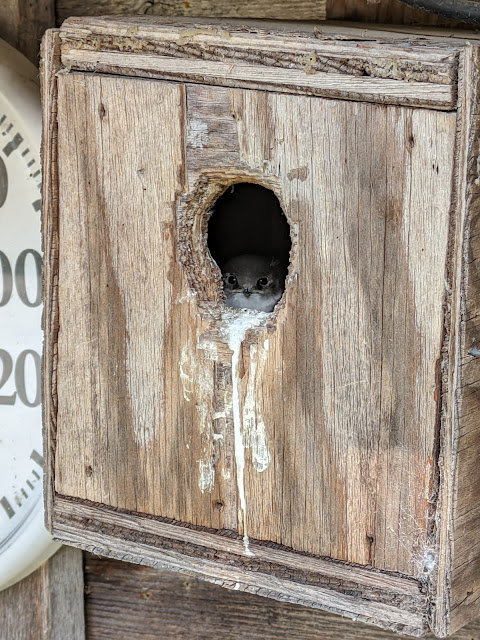
  This shot is from Hope, Alaska.  While we were waiting for our food, I could hear the little chirps. The point of the week, of course, is to bring awareness to the disappearance of natural sites.  It encourages paying attention to local nesting birds and to put up boxes to support the conservation of breeding birds. Going with nests, and since I'm off tomorrow, I'll leave you with the eaglets.

Save the Eagles Day

Image
  Jackie and Shadow of Big Bear Valley. They were spotted mating earlier this month and they've been prepping the nest. The female stores the sperm until she is fertile and ready to lay eggs. Jackie is about 11 years old and Shadow is 9.  They have been together since 2018. They engage in bonding behavior as they reconnect, with love nips and chortles. For now, they just seem to be enjoying each other's company. The Friends of Big Bear Valley focus on "educating not only our members and the public about our valley's special environment, but also on educating the governmental agencies whose job it is to enforce the local, state, and federal environmental laws. We save the eagles by knowing them and protecting them, cheering for their eggs to hatch and their eaglets to survive. Site

Animal Life - Scrub Jay

Image
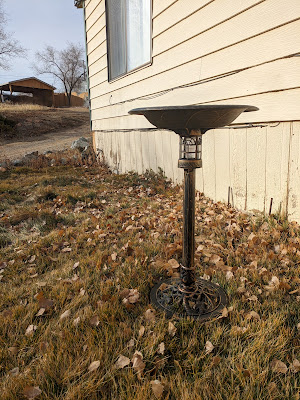
  Hubby got me a bird bath for Christmas, but instead of water for now, we put some peanuts in the basin. To lure the Scrub Jays. I'm really going to enjoy this. All About Birds

National Bird Day

Image
  The American Bald Eagle In 1864, Charles Almanzo Babcock declared the first holiday to celebrate birds.  He was passionate about advancing bird conservation and raising awareness about birds kept in captivity.  Now the project is part of the Avian Welfare Coalition. Nevada: Mountain Bluebird California Quail The mockingbird represents Arkansas, Mississippi, Tennessee, as well as Florida, although the latter is considering a change to the American flamingo. AWC

Animal Life - Kākāpō

Image
  Also known as an owl parrot, these are large flightless birds endemic to New Zealand. Their short wings are for balance, and their feathers are much too soft to be able to support flight. They have strong legs though that get them around, even able to climb trees.  Then they use their wings as a parachute to return to the ground. Google is celebrating their Street View feature today which includes a walk-through of their forest sanctuaries. Here These birds are critically endangered, but increasing.  Thanks to recovery plans and conservation efforts, they're being moved to predator-free islands with habitat protections. Before mammals such as cats, rats, and stoats were introduced, the kakapo only had to worry about the eagles from above.  Their defense mechanism is to freeze and blend in with the background, but the mammals can smell them, and they have no way to protect themselves. Here's a nest cam from earlier this year. Facts

Animal Life - Hummingbirds

Image
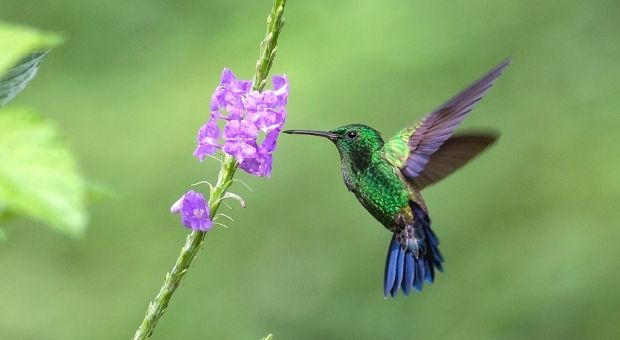
  There are about 361 species and 113 genera of hummingbirds and they occur from Alaska to Tierra del Fuego.  They are mostly found in the tropics, such as Ecuador, where over 132 species live. Named and known for their fast beating wings, which produce an audible hum, rates vary from 12 beats to around 80 beats per second in the smallest hummingbirds. The bee hummingbird of Cuba weighs only 1.95 grams and is the world's smallest bird. As you might guess, they have the highest mass-specific metabolic rate of any homeothermic animal.  Because of this, they are also one of the few groups of birds known to go into torpor, a deep sleep-like state that allows them to slow down when temperature and food conditions demand it. Speaking of Ecuador - this hasn't been very lively, but maybe we'll catch something cool. This one definitely has more visitors. Smithsonian