Posts

Showing posts with the label Marine

Science is Fun Fridays!

Image
  Often called the "rainforests of the sea," coral reefs are just as important, supporting over 25% of marine life.  If an area of the Amazon turned white, we would be concerned. But scientists have been fighting for years to make us understand the global red flag of dying reefs. When they collapse, it's not just a loss of biodiversity, it's a loss of human food security and coastal safety. The  Allen Coral Atlas  is powered by Arizona State University, originally conceived by Paul Allen. Teams have mapped reefs across the globe, and continue to monitor for bleaching events.  All it takes is a 2 degree rise in water temperature for the corals to stress react by purging the algae that lives within it. The algae is what produces 90% of the coral's energy through photosynthesis.  Without the algae, the polyps turn clear, so all we see is the skeletal structure.  Without enough energy to eat, the coral will eventually die. Okay, so not fun-filled informati...

Science is Fun Fridays!

Image
  Malpelo Island is a barren rock about 300 miles off the coast of Colombia.  In the ocean, three currents come together, creating upwellings of nutrient-rich waters, attracting a large number of sharks. More than 75 different species. Among them is what some locals came to call the Monster Shark.  Divers were able to go down the shelf enough to approach one up close in order to attach a recording device.  Once they obtained the data, they were able to confirm it's a Smalltooth Sandtiger shark. They prefer the cool, deep waters in temperatures from 43-68 degrees.  Females can grow as much as 11 feet, but some reports suggested the ones around Malpelo are closer to 20 feet. While populations in Australia and the Mediterranean are declining, these Colombian waters are protected as a marine sanctuary. In 2006, it was declared a UNESCO World Heritage Site.

Science is Fun Fridays!

Image
  The first ever encounter with a live Sulawesi coelacanth has been reported by divers off the coast of Indonesia, photographed for the first time in the wild. They were thought to have gone extinct millions of years ago, but then in 1997 one showed up in a fish market.  It was quickly given protected status to avoid intentional fishing. One was caught in 1998 and was given to an ichthyologist, who was able to document its coloration, fin movements, and general behavior.  It didn't survive the catch, and was donated to the Indonesian Institute of Sciences. It is locally called raja laut, or King of the Sea. Coelacanths are an ancient species of lobe-finned fish, and there are only two living species.

Aquatic Animal Day

Image
 My shot from the Seymour Marine Discovery Center in Santa Cruz. I've always been intrigued by sea anemone but never quite sure of what's going on, so that's our direction today. While they largely stay in one place, they are predatory.  Their tentacles contain nematocysts, or stinging cells, that paralyze prey.  The venom is harmless to humans though. And you may know that clownfish are able to withstand these stings so they like to hang out for protection and they clean the anemones of parasites. My shot from Mattole, Pacific Coast. The giant green anemone is intertidal, seen here in a tide pool. They feed on crabs, mussels, small fishes, and sea urchins.  We did see it try to grab something it thought might be food.  And we saw what it would've liked on the shore nearby.

Science is Fun Fridays!

Image
 A research program led by the Australian National University has been studying blue whales in the waters off the coast of Timor-Leste in Southeast Asia. This part of the sea is known as a "crustacean hotspot" that many whales regularly pass through.  Deep ocean channels serve as a major migratory highway between the Pacific and Indian Oceans. The nearshore waters, particularly in the Ombai-Wetar Straight, provide one of the most accessible locations for blue whale research. For the first time, we have footage of a mother nursing her calf. These waters "really are providing blue whale scientists with some of our first glimpses into the private lives of one of the world's largest but most elusive animals," says Associate Professor Karen Edyvane.  (She is also Adjunct Senior Research Fellow at Charles Darwin University). This information suggests that the region is not only important for foraging, but is also critical for reproduction and early life. Although stil...

Science is Fun Fridays!

Image
  The oldest known marine plant has been discovered in the Baltic Sea, at 1400 years old. This seagrass, known as eelgrass, produces ramets, an individual member of a clone that can separate and become capable of independence. Genetic variation within these ramets can be used to age them, using a genetic clock.  As mutations occur they become fixed and accumulate in descendant ramets.  The clock compares the plant to the descendants and ages it based on their differences. The team is continuing their study and expect to find even older seagrass. This is all part of an ongoing effort in the scientific community to locate and document the oldest of living things before they're possibly gone forever.

Science is Fun Fridays!

Image
  Chimaeras are a group of fish also known as ghost sharks.  The species is related to sharks but are thought to have diverged around 400 million years ago. In October 2018, a deep-sea survey collected the above specimen in the Andaman Sea off the coast of Thailand.  It was recorded as Chimaera aff. macrospina  but further research has concluded this is a new species. Members of the Chimaeridae are told apart by differences in their snouts and the position of their anal fins.  This one has a short snout and large oval eyes, which are iridescent green.  It has been named Chimaera supapae, in honor of Professor Supap Monkolprasit, who devoted her life to the study of cartilaginous fishes in Thailand.

Underwater Photography 2023

Image
 Photographer of the Year - Kat Zhou 'Boto encantado' Most Promising Photographer - Theo Vickers 'An island's wild seas' Wide Angle Photographer - J. Gregory Sherman 'Fade' Macro Photographer - Shane Gross 'Unsung' Wrecks - Brett Eldridge 'Engine with a saddle' Behavior - Yury Ivanov 'Make love not war' Portrait - Suliman Alatiqi 'The trunk' Black and white - Don Silcock 'El blanco - The White One'

Science is Fun Fridays!

Image
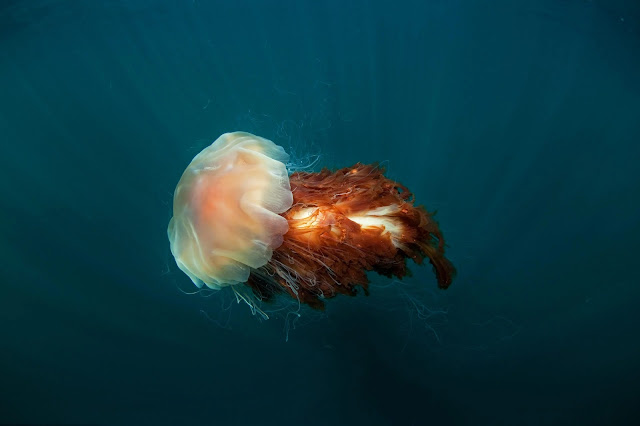
  The Giant Jellyfish - The Lion's Mane - Arctic Red - Hair Jelly It is one of the largest known species of jellyfish, attaining a bell diameter over 6 feet.  The bell is divided into eight lobes, and each lobe contains 70-150 tentacles arranged in four rows.  Their sting is painful, but not poisonous, although some people could have a severe allergic reaction. Along the bell margin is a balance organ, called the rhopalium, which helps the jellyfish orient itself. They reside in the cold waters of the northern oceans as well as the English Channel, Irish Sea, North Sea, and western Scandinavian waters.  It may drift into the Baltic Sea but it cannot breed there due to low salinity. Their life cycle is just a year long.  The female carries her eggs in a tentacle where they grow into larvae.  She then deposits them on a hard surface where they grow into polyps.  These reproduce asexually, creating small creatures known as ephyrae.  Individuals break...

Animal Life - Whale Shark Day

Image
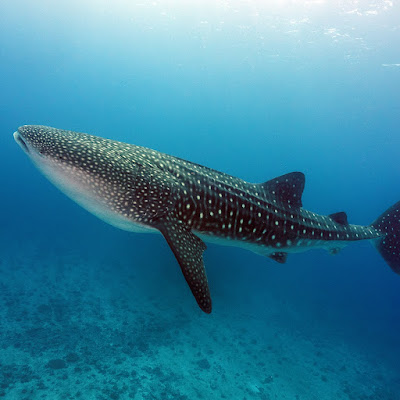
 The whale shark is in fact the largest fish in all the sea.  The largest on record was 61.7 feet long. They're slow moving filter feeders, hence the whale name.  They have 300 rows of tiny teeth and 20 filter pads, and unlike most sharks, their mouth is located on the front of the head. Their skin is unique like our fingerprints, and can be up to 15cm thick.   They are the sole member of the family Rhincodontidae.   While pupping has never been documented, in 2019 grounds may have been located in the Ticao Pass of the Philippines.  During a WWF Photo Identification series, there were numerous resightings of previously recorded sharks and many juveniles were spotted. Because of their pace and preference to roam in shallow waters, they are quite vulnerable to ships and fishing nets.  In 2016, the IUCN listed them as endangered, their numbers decreasing.  Recently assessed, the classification is now "largely depleted." China is still opera...

Underwater Wednesday

Image
  Specifically, the winners from the Ocean Art Underwater Photo Competition. Compact Behavior PT Hirschfield Compact Micro Kathrin Landgraf-Kluge Compact Wide-Angle Kate Rister Black and White Tom St. George Underwater Art Jenny Stock Conservation Catherine Holmes Coldwater Matthew Sullivan Blackwater Steven Kovacs Nudibranch Salvatore Ianniello Portrait Paola Bausani Macro Nigel Motyer Wide-Angle Eduardo Acevedo Marine Life Behavior and Best of Show Luc Rooman Ocean Art

Science is Fun Fridays!

Image
  Evergreen.edu - Animating the Sea Barreleye fish are equipped with a see-through head so that their eyes can view above as they navigate the dark depths of the ocean, approximately 2,000 to 2,600 feet down. The "vision balls" are not the front facing conventional looking eyes, but rather the glowing green orbs.  The front is actually their olfactory organs, which can smell chemical cues in the water. They often steal their food from the dangling tentacles of siphonophores, as they move above the fish.  The eyes are incredibly well adapted to spotting the silhouettes of edible animals, such as small crustaceans.  The eyes then roll forward as they eat - apparently they watch their small mouthfuls so as not to overtake. The Monterey Bay Aquarium Research Institute recently came across one of these creatures with their ROV, Ventana. MBARI also has a second ROV, Don Ricketts.  Together they have logged more than 5,600 successful dives and recorded more than 27,000...

Science is Fun Fridays!

Image
  Ocean Photographer of the Year Awards Exploration Photographer: Martin Broen Young Photographer: Hannah Le Leu Female Fifty Fathoms Photographer: Renee Capozzola Conservation Photographer: Kerim Sabuncuoglu Highly Commended for Conservation Photographer: Nicholas Samaras Adventure Photographer: Ben Thouard Collective Portfolio Photographer: Stefan Christmann Photographer of the Year: Aimee Jan Second Place: Henley Spiers Third Place: Matty Smith Nominee: James Ferrera Nominee: Steven Kovacs

Science is Fun Fridays!

Image
  An atolla jellyfish, photographed by the SuBastian ROV, as part of the Designing The Future 2 expedition. "The ocean's midwater is considered to be the largest habitable space for life on earth, yet it is also one of the most minimally explored marine environments." Of course, it is difficult to study life here because the animals are fast, fragile, and often quite small.  They can't be taken out of the environment due to changes in pressure, so this team is testing new technologies to be able to study "open ocean species in situ." I wanted to discuss something in particular that they came across, a pyrosome. These are free-floating colonies of zooids connected by tissues that communicate and coordinate behavior, such as propelling the colony forward.  Each individual zooid pulls water through a plankton filtration system and then expels the water into the inside of the cylinder body.  This gives them propulsion mobility. They can grow so large that a huma...