Posts

Showing posts with the label Hubble

Science is Fun Fridays!

Image
  Astronomers were able to use Hubble's powerful ultraviolet sensitivity to witness a passing star get ripped apart by black hole AT2022dsb. The All-Sky Automated Survey for Supernovae checks the sky about once a week for "violent, variable, and transient events that are shaping our universe."  By monitoring tidal events, they were able to catch this early enough, and it happened close enough, that astronomers could run ultraviolet spectroscopy over a longer period of time than usual. The data will provide forensic clues as to what happens to a star when it meets a black hole. "This is an exciting place for scientists to be: right at the interface of the known and the unknown." -Peter Maksym of the Center for Astrophysics #HubbleFriday
NASA News

Image
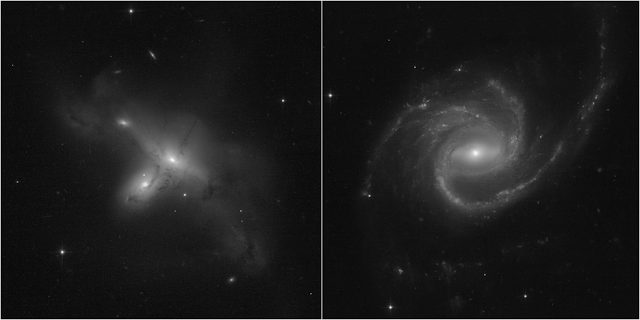
On  Asteroid Day  it was mentioned that the Hubble Telescope had been reported down. As of yesterday, it is back in action! These images confirm Hubble's return to its mission, capturing galaxy MADORE2115-273 on the left, and ARP-MADORE0002-503, an unusual spiral galaxy with three arms. On June 13, Hubble's payload computer, which controls and coordinates the science instruments onboard, stopped working.  When the main computer failed to receive a signal, it shut down into safe mode. One thing to remember is the Hubble was built in the 1980's, so when the team on the ground had to figure out what was wrong with it, they had to look back on previous technology and the knowledge collected from the staff over the years.  Retired alumni did come in to assist, including those who had helped build it. "That's one of the benefits of a program that's been running for over 30 years: the incredible amount of experience and expertise," says Nzinga Tull, the Hubble Sy...

Science is Fun Fridays!

Image
Credits: NASA, ESA, and J. DePasquale Meet Comet 2I/Borisov. Hubble caught this image on October 12 - the speed and trajectory suggest this object has come from beyond our solar system, and is therefore the first confirmed interstellar comet. Scientists hope to obtain "invaluable clues to the chemical composition, structure, and dust characteristics of planetary building blocks." The comet was photographed 260 million miles from Earth.  It is following a hyperbolic path around the Sun, and is expected to make its closest approach to the Sun in December.  By the middle of 2020, it is expected to pass Jupiter on its way out of our solar system. Crimean astronomer, Gennady Borisov, first spotted the comet in August. NASA