Posts

Showing posts with the label Space

A Glorious Dawn

Image
  But a busy day for me. Back in 2016, Jack White's Third Man Records launched a "space-proof" turntable 94,000 feet up using a high-altitude balloon. The first vinyl to play in space was Symphony of Science composer John Boswell's song from Carl Sagan's Cosmos.

Science is Fun Fridays!

Image
  The sugar in raspberries is called erythrulose, and it has been found near the center of our Milky Way. "It opens up the possibility of discovering in space other sugars such as ribose, which is part of RNA, and other important molecules for the origin of life," says co-author, Carlos Briones.  Erythrulose can change into the ingredients that create nucleic acids, which are essential to life. There were previous reports of a dust cloud, called Sagittarius B2, that radio telescopes determined smells like raspberries, (caused by ethyl formate), but this is the first time sugar has been found in the interstellar medium - the space between star systems in a galaxy.

Science is Fun Fridays!

Image
 The Pillars of Creation. Hubble vs Webb

Science is Fun Fridays!

Image
  The James Webb Telescope celebrated its 4th year in space yesterday. And it recently discovered something surprising - a Jupiter sized exoplanet with diamonds and soot in the atmosphere. The planet doesn't have the familiar helium-hydrogen combination, but is helium-carbon instead.  There are no common molecules of water, methane, or carbon dioxide. "It's very hard to imagine how you get this extremely carbon-enriched composition.  It seems to rule out every known formation mechanism," says lead author, Michael Zhang. Even more weird is the host star, which is a neutron sun.  No other pulsar is known to have a gas-giant planet, and few pulsars have planets at all. The planet is also closer to its star than Earth is to our Sun, whereas gas giants in our system are much farther out.  It is lemon-shaped because the gravitational forces of the pulsar are pulling so strongly. Molecular carbon doesn't appear in planets that are very close to their sun, due to extrem...

Science is Fun Fridays!

Image
 The 3I/ATLAS comet, as it made its closest approach to Earth last night/this morning. This shot was captured by the Gemini Multi-Object Spectograph in Hawaii. The comet's journey is expected to continue towards Jupiter, crossing the orbits of Saturn, Uranus and Neptune by 2028, and then heading out to interstellar space, never to be seen again. From 168 million miles away, scientists will be able to study material from beyond our solar system. They were able to detect an X-ray glow, revealing hidden gases and solar wind interactions.  Analyzing those gases can reveal the chemistry of other star systems, with which scientists can test models of planetary formation and investigate early galaxy evolution. The James Webb Telescope already detected abundant water vapor, as well as carbon monoxide and carbon dioxide.

Science is Fun Fridays!

Image
  Perhaps you saw some aurora this week, thanks to a solar storm. But that caused a delay for the new Mars Mission launch, the Blue Origin New Glenn rocket. It was scheduled for November 12, but was able to go up yesterday instead.  It was originally supposed to launch in October of 2024, but a series of technical and scheduling issues brought us to November 2025. All this is for the ESCAPADE spacecraft - Escape and Plasma Acceleration and Dynamics Explorers - and it is meant to study the exact kind of space weather that delayed it. As the sun releases large clouds of plasma, known as coronal mass ejections, the electricity charged material triggers auroras when the particles interact with Earth's magnetic field lines and atmosphere. ESCAPADE will examine how this weather, as well as solar wind, previously stripped Mars of the thicker atmosphere the planet used to have.   Mission

Science is Fun Fridays!

Image
 This is, of course, an artist's rendering, but astronomers did spot a record-breaking black hole eruption, brighter than 10 trillion suns. It may be consuming a star 30 times more massive than our sun. It is the most powerful and distant energy flare ever recorded.  Classified as TDE J2245+3743, this active galactic nucleus is 10 billion light years away, and yet its brightness was still clearly visible above the black hole's usual activity. The newly completed Vera C. Rubin Observatory should help researchers find more events like this.  It will conduct a 10 year survey of the sky, mapping the Milky Way. Rubin

Science is Fun Fridays!

Image
  This is Arrokoth, located in the Kuiper Belt, as photographed by New Horizons. Launched in 2006, its primary mission was to collect data on Pluto and its moons.  This was completed in 2015, and then NASA sent the spacecraft towards the object above. Arriving in 2019, it was confirmed to be a cold object, not "because it's far from the Sun; it's dynamically cold.  Its orbit has been pretty much the same for the entire history of the Solar System," according to New Horizons mission scientist, Carey Lisse. Cold objects make up about 1/3 of the Kuiper belt, suggesting they haven't been much disturbed by the giant planets. Scientists learned that the clumping wasn't violent either, they appear to be just touching each other, "like they are kissing, or if they were spacecraft they would be docking," says co-investigator William McKinnon. Further study of such objects can tell us a lot about the formation of the Solar System. New Horizons  is still operat...

Science is Fun Fridays!

Image
 The NASA crew is one step closer to the Artemis II mission - originally expected last year, now planned for April 2026. In early June, the lunar science team ran a mission simulation for the first time in the newly completed Science Evaluation Room in Houston. This room will support the mission's main flight control room, equipped for rapid data interpretation, collaborative analysis, real-time decision making, and seamless coordination between the science and operations teams. Through Artemis, NASA will send astronauts to explore the Moon for scientific discovery, economic benefits, and build the foundation for the first crew to Mars.  The first launch will be a trip around the Moon, to confirm all of the spacecraft's systems are operating as designed in the actual environment of deep space.

Science is Fun Fridays!

Image
 Perhaps you saw the smiley face from space this morning, as this triple conjunction was visible from about 5:30am to sunrise. Another early morning watch to plan for is the Eta Aquarids meteor shower, which will peak in the hours before dawn on May 5 - but they're active from April 15 through May 27, starting around 2am. The chunks of space debris that create these showers are from Halley's Comet. The comet itself is visible from Earth every 72-80 years.  It was last seen in 1986 and will be back around 2061.

Pluto Day

Image
 On this day in 1930, American astronomer Clyde Tombaugh discovered Pluto at Lowell Observatory in Flagstaff, Arizona. The heart shape there is named the Tombaugh Regio in his honor. The western lobe, called Sputnik Planitia, is a plain of nitrogen and other ices lying within a basin.  The eastern lobe consists of reflective uplands thought to be coated in nitrogen transported through the atmosphere from the west.  Some of this nitrogen returns to the basin via glacial flow. Percival Lowell, who founded the observatory, had always believed there was a 9th planet in our solar system.  He died 14 years before it was found. Before him, in the 1840's, Urbain Le Verrier had predicted the existence of Neptune through mathematics.  To explain discrepancies in Uranus' orbit, he provided calculations to Johann Gottfried Galle, who was able to locate the planet.  But then they realized there had to be something else disturbing Uranus as well.... It's been almost 20 y...

Science is Fun Fridays!

Image
Astronaut Suni Williams just completed the longest spacewalk time for a female. Part of her mission, along with astronaut Butch Wilmore, was to swab the surface material around the airlock and outside the Destiny laboratory. The ISS External Microorganisms investigation has been ongoing - with previous samples collected back in June. There are life support vents outside the Destiny module, and scientists want to examine whether a spacecraft releases microorganisms, and if so, how many and how far they may travel.  Can they survive, even thrive, out there? Lichens, bacteria, tardigrades and more have been shown to be able to withstand the harsh space conditions - no air, lots of cosmic radiation, and temperatures from about 250 to -250 degrees F.  

The Planetarium

Image
  Over the weekend, Hubby and I took our nieces to the planetarium.  Neither one of us had been since we were kids on a field trip.  This is something we need to do more! The movie we caught wasn't entirely space related, but of course we went over the night sky first.  With the dome theater, anything is cool. We learned that the dome is getting a full LED upgrade, and will be the first on a college campus.  Not only does this mean better movie quality, but it will also provide a new way for students to learn with astronomy simulations and immersive software. This is through a partnership with Cosm, a global technology company, and a donation from the George W. Gillemot Foundation to establish an Aerospace Engineering Department at UNR's College of Engineering. Built in 1963, the Fleischmann Planetarium was the first in the country to feature a 360 degree projector.  It was built by local architect, Raymond Hellmann, and is protected on the National Registe...

Science is Fun Fridays!

Image
  Juno's latest flyby of Jupiter caught storms a-swirlin'. In the image, we're seeing exaggerated color and contrast, but still. What it shows is the complex, variable, and turbulent atmosphere of the planet. Juno has also helped answer a question astronomers have long wondered about - Jupiter's rings. They exist, faintly, under infrared light - but compared to Saturn they should be amazing.  However, the planet's Galilean moons are so big and influential that they have and would destroy any ring system.   Jupiter is currently very visible in the night sky a few hours after sunset.

Science is Fun Fridays!

Image
  A near-Earth asteroid, named 2024 PT5, has been pulled into orbit for a mini-moon! It's about the size of a school bus, so it cannot be seen with the naked eye, or even a backyard telescope. But it is within the brightness range of typical telescopes used by professional astronomers. PT5 is expected to stick around until November 25, when it should break free of Earth's influence. How cool would it be if we could actually see two moons?

Science is Fun Fridays!

Image
  On August 19-20, the European Space Agency will attempt the first Lunar-Earth Flyby, using double gravity assist. The JUICE mission, or "Jupiter Icy Moons Explorer," is testing this maneuver to save propellant, which will be used later in the mission. The move requires launching the spacecraft at a precise second so that it will find the Moon and the Earth in the right position. Celestial travel is a game of give and take - the more you can coast by stealing speed from planets, the more fuel you'll have later. Once the spacecraft reaches Jupiter, and after many flybys, it will enter the orbit of Ganymede.  Having saved some fuel, it will be able to go about 120 miles above the surface to conduct more precise observations.

Science is Fun Fridays!

Image
  In May of this year, NASA tracked the most intense solar storm in decades.  The Solar Dynamics Observatory recorded 82 notable solar flares. This video highlights flares classified at M5 or higher, with nine categorized as X-class - the most powerful being an X8.7 flare, recorded May 14. This video shows a solar storm messing with Rover's camera on Mars. While auroras are beautiful, they can signal danger as well.  Scientists have been working to identify when these storms can cause the most devastation, and new research emphasizes the influence of the angle at which an irregularity in the solar wind arrives. Most often we are hit at a substantial enough angle to produce a glancing blow, but more direct hits create the strongest currents (above 20 amps) in long stretches of conducting material.  In this day and age, with our powerlines and pipelines, this can be worrisome. In Mantsala, Finland a gas pipeline received 332 shocks between 1999 and 2023.  The resu...

Science is Always Fun!

Image
  A nova called T Coronae Borealis erupts every 80 years, and it's due anytime between now and September. First known to be observed in 1217, by an abbot of the Ursberg Abbey in present-day Germany.  He saw a faint star that shone with great light and then returned to its original faintness. He was witnessing a thermonuclear explosion 3,000 light-years away, where a white dwarf devours matter from a nearby red giant star, and then erupts when it gets full. The red giant snows hydrogen on the white dwarf's surface, which heats up and eventually ignites, sparking a chain reaction. Novae can repeatedly and catastrophically erupt, enriching their celestial surroundings with the elements needed for life, such as carbon, nitrogen, oxygen, and could be one of the main producers of lithium. When it does burst, it will be visible for several days. The Corona Borealis constellation can be found next to Hercules. As I will be off tomorrow for another camp.  :-)

Webb Wednesday

Image
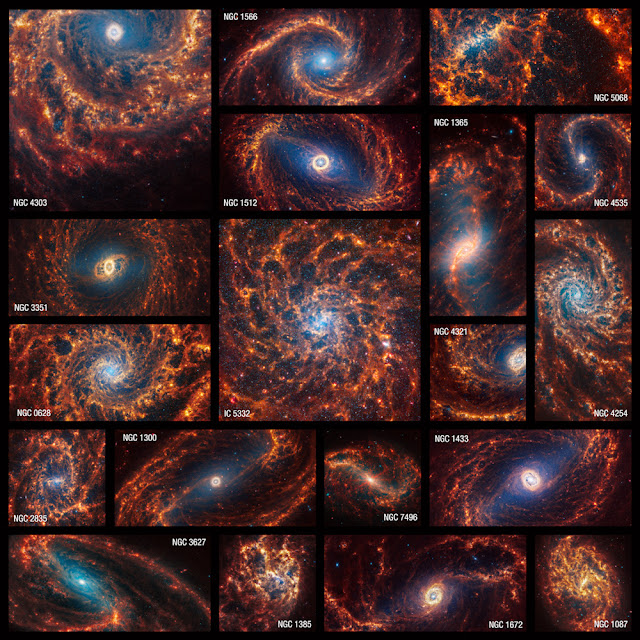
  The James Webb Telescope observed 19 nearby spiral galaxies in near- and mid-infrared light. Webb's NIRCam (Near-infrared) captured millions of stars in these images, which sparkle in blue tones.  The MIRI (mid-infrared instrument) highlights the glowing dust, and the stars that aren't fully formed, still encased in gas, as the red dots. This is part of an ongoing project with the PHANGS program (Physics at High Angular resolution in Nearby GalaxieS).  The team also has data from Hubble, the Very Large Telescope's Multi Unit Spectroscopic Explorer, and the Atacama Large Millimeter/submillimeter Array, which includes observations in ultraviolet, visible, and radio light. Here we have NGC 628 split diagonally with Webb imagery at top left and Hubble at bottom right. This galaxy is 32 million lightyears away, in the constellation Pisces. Article

Science is Fun Fridays!

Image
  I came across this MIT class called "Making Art for Scientists." Marcelo Barrazza is a postdoc in astronomy, and he wanted to develop a way to represent the process by which planets and planetary systems are born. Here we see a visualization of the protoplanetary disk. Link A recent observation of these disks led to a carbon monoxide finding - for years astronomers have noted that more should be visible in the formation of planets.  They've now discovered there is, trapped in ice formation around the disks. The team used a model designed to study clouds on exoplanets. "Carbon monoxide is essentially used to trace everything we know about disks - like mass, composition, and temperature.  This could mean many of our results for disks have been biased and uncertain because we don't understand the compound well enough," says lead author, Diana Powell, Center for Astrophysics, Harvard & Smithsonian. Link