Posts

Showing posts with the label Night Sky

Blue Supermoon

Image
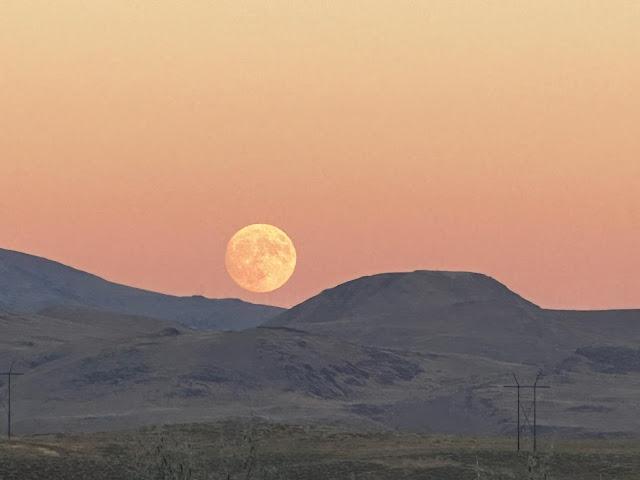
  This was last night from our porch, and tonight it will be bigger and brighter! The biggest and brightest of 2023, in fact. The moon will be a little over 222,000 miles away, which is "exceptionally close." "Once in a blue moon" occurs about every 2 and a half years or so.  But a blue supermoon won't be seen again until 2037.

Science is Fun Fridays!

Image
  It's that time of year again - the Perseid Meteor Shower! The peak was mostly this early morning, but it lasts through the 24th. Every year we cross paths with Comet Swift-Tuttle, the largest object known to repeatedly pass by. Looks to the Northern Hemisphere and the constellation Perseus. We're going to be camping up near Lassen Peak this weekend, but we're also a full moon tonight.... Still, I intend to bring my telescope along this time.

Beaver Blood Moon Lunar Eclipse

Image
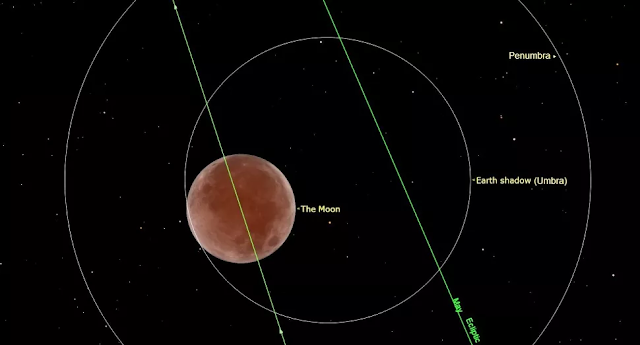
  The November full moon, also known as the Beaver Moon or Frost Moon, always shines near the stars of Taurus and Aries.  It will reach its full phase on Friday morning, 3:57 EST.  At this time, it will be passing through Earth's shadow for a partial eclipse.  Only a thin sliver of the southern rim will be outside the shadow, with a 97% reddish hue. It will be visible to everyone on the night side of Earth. For my area, maximum eclipse will be 1:02am but it may be overcast.... Schedule by Location This eclipse will be the longest partial since 1440, lasting for 104 minutes. Space Leisure

Science is Fun Fridays!

Image
 The Draconids meteor shower lasts from October 6-10, but tonight will be the best viewing. They are one of the most convenient to watch since their constellation is highest in the sky during nightfall, but because they are slow moving meteors, they are faint and frequently burn out before they reach Earth's atmosphere. The showers were first spotted in 1933 when several thousands meteors per hour were reported.  They follow on the tail of comet 21P/Giacobini-Zinner, first seen in 1900. In other space news: It has been confirmed that Jezero Crater was once a Martian lake. Evidence of deltas from satellite observations supported the idea, but Perseverance's work on the ground has confirmed it.  Sediment arrangements known as "scarps" suggest the flow of the deltas turned into a lake, and that episodes of dramatic flooding shifted the massive boulders found in the crater. The hope is that there may be evidence of ancient life in the samples the rover has collected. IFL ...

Perseid Meteor Shower

Image
 Tonight begins peak viewing time for the Perseid Meteor Shower, specifically between midnight and dawn Thursday morning.  This year we have just a crescent moon, so not too much brightness to interfere. The showers happen every year in August as Earth passes through the stream of Comet Swift-Tuttle. It is the largest solar system object to pass by so close repeatedly, but astronomers know its orbit well by now, "well enough to say we are safe from an impact for many thousands of years." Cometary crumbs slam into our atmosphere, causing the fragments to glow as shooting stars. The McDonald Observatory in Texas will be sharing a live feed with a live chat for questions. There will be other live streams as well from various locations, including Arizona, New York, and Rome. Space

Super Flower Blood Moon Eclipse

Image
 My cousin's picture of the moon over Peavine. Along with being the largest supermoon, this was also the only total lunar eclipse of 2021. The Griffith Observatory in Los Angeles provided a live stream. In the penumbra phase, Earth's shadow blocks sunlight imperfectly, so the moon is still visible but dimmer.  In the umbra phase, the moon is in complete shadow, which is called totality. An image from Hong Kong, taken by Anthony Wallace (AFP via Getty Images) Space

Science Tonight!

Image
  The Orionid Meteor Shower Peak morning is October 21.  The moon is in waxing crescent phase, so with clear skies, you should be able to view tonight as well. Each year the Earth passes through the stream of debris left by Comet Halley, the parent comet of the Orionids.  They're not the strongest shower, or the brightest, but they do leave persistent trains - ionized gas trails that last for a seconds after the meteor is gone. Orion ascends in the east after midnight, and though the meteors radiate from nearby, they radiate in all directions, and become visible about 30 degrees out from their radiant point, so they will be seen all over the sky.   The meteors strike our atmosphere going about 41 miles per second, vaporizing some 60 miles above Earth's surface. Enjoy your viewing! EarthSky

Look to the Sky

Image
Tonight's full moon is called the Milk Moon, or Flower Moon, named in honor of the wildflowers blooming this time of year and for the Month of Three Milkings. The latter refers to a name recorded by Venerable Bede in De Temporibus (708) in reference to May, when cows could apparently be milked three times a day. * Comet Swan was discovered last month, and is currently travelling about 85,000 miles towards Earth.  On May 13 it will make its closest approach to us, and then on May 27, it will be closest to the Sun.  As they near the Sun, comets are blasted with radiation.  This warming leads to a release of gas and dust, which are the tails we can see. Astronomers say it has a greenish color, so keep a lookout - although it will be best seen from the southern hemisphere.