Posts

Showing posts with the label Moon

Science is Fun Fridays!

Image
  Scientists have compiled the first map of fault ridges in the Moon's basaltic plains. The lunar maria were formed by lava flowing into ancient impact basins, and these findings reveal that lunar tectonic activity is more widespread, and more recent, than previously thought. The Moon doesn't have tectonic plates that move like the Earth's, but it does have its own internal activity.  Surface features such as lobate scarps are evidence of thrust faults created by global contraction. That's right.  The Moon is shrinking, wrinkling up its surface. And when those faults slip, they trigger moonquakes. "The widespread presence of recently or currently seismically active tectonic features across the maria provides new opportunities for future lunar missions and investigations.  The distribution of SMRs may also be of relevance to any long-term lunar habitation due to the hazards that shallow moonquakes pose to human-made infrastructure," the researchers write.

Happy New Year!

Image
  "Just as the moon brings new phases, may this year bring you new hopes and dreams." It's not a new moon though, it's a waxing gibbous.  The first of 2026 will be January 18th. January 3rd will be the Super Wolf Moon, the first full moon of the year and the last in a series of supermoons. We'll be out camping under it.  ^_^ I wish you all the happiest New Year, and I thank you all for being here. See you next year!

Lunar New Year

Image
  Enter the Year of the Wood Snake! Each year alternates between Yin and Yang - last year's dragon was Yang Wood, "a rigid, divisive and often angry nature," whereas this year's Yin Wood is associated with flowers, "easygoing, flexible and diplomatic." The snake also contains Yin Fire, predicting a "highly creative, collaborative and exciting year." The snake itself is most commonly associated with intelligence, resilience, and love.  A potential for self-cultivation, shedding bad energy.

This Day in History

Image
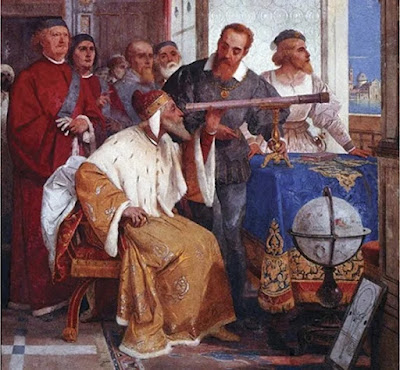
  Painting by Giuseppe Bertini On this day in 1609, Galileo began observing the moon with his telescope. Dutch eyeglass makers had invented the telescope in 1608, but Galileo improved upon it greatly.  He ground and polished his own lenses for greater magnification. He found that the surface of the Moon was not smooth, but full of mountains and valleys like Earth.  He was the first to publish a detailed report of his findings in 1610, called Starry Messenger (Sidereus Nuncias). Galileo's drawing: Of course, the Roman Catholic Church had adopted Aristotle's beliefs that the heavenly bodies were perfect and the Earth was at the center, which is why Galileo was forced to recant in 1633 and remained on house arrest until his death in 1642. You may recall I previously shared a photo of Galileo's lens, on display in Florence. It is adorned with a frame commissioned by the Medici in 1677, designed by Vittorio Crosten. The Galilean telescope used a convergent objective lens and a...

Science is Fun Fridays!

Image
  Back in 2019, China's Chang'e 4 lander planted cotton seeds on the lunar surface, (but not in lunar soil). It only took a couple weeks for the plant to sprout, marking the first biological experiment on the moon. But additional study was needed to determine if lunar crops are less productive or more fragile than those on Earth.  And now, two new papers suggest that the plant may actually prefer low gravity. By comparing growth in replicated conditions on Earth, they found the less gravity speeds up germination.  There also seemed to be no issue with the long lunar night, which can drop to -61* and last about 18 days - the plant was still green and upright when light returned.  Back on Earth, the plants died. The researchers suspect the low gravity triggered a freezing resistance some polar plants have developed. The lander also planted rapeseed, potato, and rock cress - none of which took. Experiments on the International Space Station have already shown that plant...

Blue Supermoon

Image
  This was last night from our porch, and tonight it will be bigger and brighter! The biggest and brightest of 2023, in fact. The moon will be a little over 222,000 miles away, which is "exceptionally close." "Once in a blue moon" occurs about every 2 and a half years or so.  But a blue supermoon won't be seen again until 2037.

Science is Fun Fridays!

Image
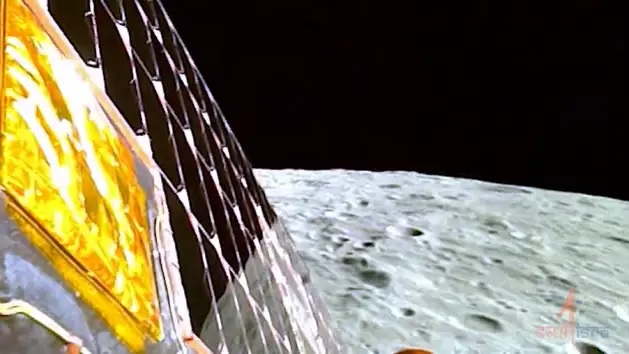
  On August 23, India became the fourth country to land on the moon, but the first to land on the southern pole. They will be the first to explore the area where recent discoveries have shown traces of water. There was somewhat of a race to revisit the moon, but Russia and Japan's spacecraft crashed into the surface.  The US has a crewed mission planned for 2025. The south pole of the moon has more craters than where we've landed before, and the angle of the sun leaves many of them in total darkness. The mission, named Chandrayaan-3, transported the rover Pragyan. After setting tire to the surface, the rover moved around and confirmed all systems are a go. Which means a main objective of the mission is already complete.

To the Moon, Artemis!

Image
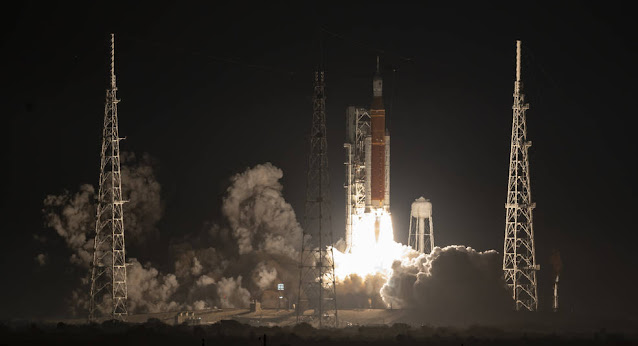
  NASA's Space Launch System rocket carries the Orion spacecraft. This first mission is unmanned, with an itinerary to travel 40,000 miles beyond the Moon and return to Earth in about 25 days. Artemis I is the first integrated flight test of the agency's deep space exploration systems, "helping us prepare for human exploration on the Moon and, ultimately, Mars," said NASA Administrator Bill Nelson.   Astronauts are expected to fly in the Artemis II mission in 2023. Mission I Mission II

Lunar New Year 2022

Image
  New moon, New year! The lunar calendar is based on the moon's orbit around the earth.   The tiger is commonly associated with bravery, courage, and strength - a sign of new beginnings. "This nicely coincided with hopeful recovery from the pandemic.  This actually is quite significant in terms of the symbol," said Eddy Keming Chen, philosophy professor in Chinese Studies at UC San Diego. Another basis of the zodiac are the elements, and this year is a water tiger, the first since 1962. People born in the year of the water tiger are said to be loyal and have strong relationships. In Mandarin, the New Year is referred to as Guo Nian, or to "pass over Nian." In Chinese mythology, the Nian is a beast that lives in the sea or in the mountains.  Every new year it would come out to feed on men and animals, sometimes even children.  Some legends attribute the lion dance as a means of driving away the Nian.  The villagers would bang drums and plates, throw fir...

Beaver Blood Moon Lunar Eclipse

Image
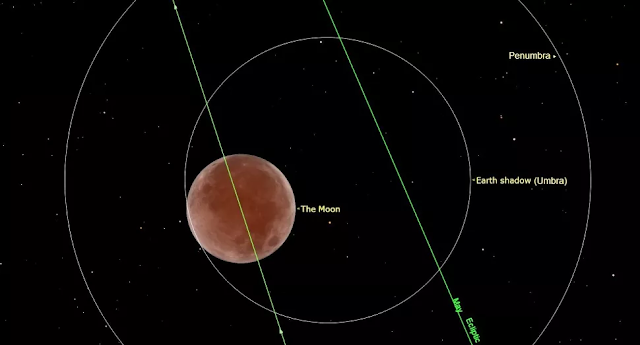
  The November full moon, also known as the Beaver Moon or Frost Moon, always shines near the stars of Taurus and Aries.  It will reach its full phase on Friday morning, 3:57 EST.  At this time, it will be passing through Earth's shadow for a partial eclipse.  Only a thin sliver of the southern rim will be outside the shadow, with a 97% reddish hue. It will be visible to everyone on the night side of Earth. For my area, maximum eclipse will be 1:02am but it may be overcast.... Schedule by Location This eclipse will be the longest partial since 1440, lasting for 104 minutes. Space Leisure

Super Flower Blood Moon Eclipse

Image
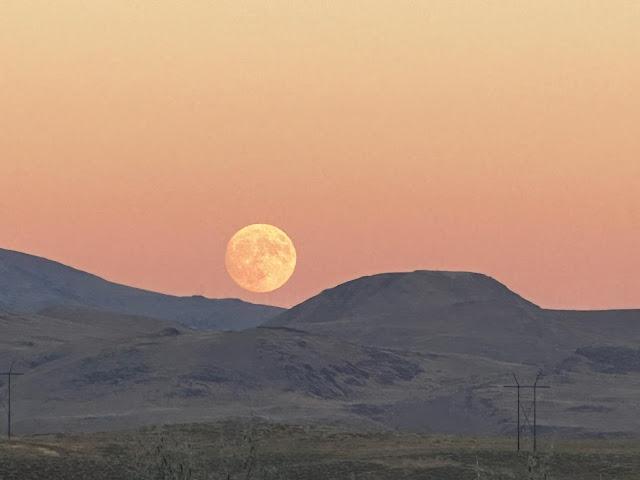
 My cousin's picture of the moon over Peavine. Along with being the largest supermoon, this was also the only total lunar eclipse of 2021. The Griffith Observatory in Los Angeles provided a live stream. In the penumbra phase, Earth's shadow blocks sunlight imperfectly, so the moon is still visible but dimmer.  In the umbra phase, the moon is in complete shadow, which is called totality. An image from Hong Kong, taken by Anthony Wallace (AFP via Getty Images) Space

Science is Fun Fridays!

Image
  Today is the Lunar New Year - Year of the Ox. The lunisolar calendar is traditional to many east Asian countries including China, South Korea, and Vietnam. Each time the moon moves into a line with the sun and the earth, a new month begins.  When the full moon appears, it is the middle of the month. Li Chun, the beginning of the Spring, is the first solar term and the first lunar month.  This date varies between January 20th and February 20th.  (See upper right side in above chart). The lunar calendar dates back to the Xia and Shang Dynasties, around the 16th century BC.  One was found in Scotland, which has been dated to 8000 BC.  Even before calendars, ancient hunters were no doubt observing the moon phases for time-measuring. The lunar calendar is also used to determine religious holidays such as Rosh Hashanah (Hebrew), Buddha's Birthday (Buddhist), Diwali (Hindu), and Ramadan (Islamic). The Gregorian calendar most commonly used today is a solar calend...