Posts

Showing posts with the label Biology

Darwin Day

Image
  Born on this day in 1809, Charles Darwin is one of the most influential figures in human history.  His theories have been fundamental to the understanding of life and the species of the world, establishing the study of evolutionary biology. He was originally enrolled at the University of Edinburgh for medical education, but instead helped investigate marine invertebrates.  His five year voyage was inspired by his interest in the diversity of fossils.  He wanted to witness life in all its unique and varied forms, which he especially found in the Galapagos islands. From his observations, he devised his theory of natural selection.  For twenty years he was working on his research, when Alfred Russell Wallace wrote to him with a similar theory, and so it was a joint submission to the Linnean Society of London. On the Tendency of Species to form Varieties; and on the Perpetuation of Varieties and Species by Natural Means of Selection  was published in 1858. Da...

Science is Fun Fridays!

Image
  I'm not going to pretend to really understand this, so I'm going to quote directly. "Researchers from the University of Chicago have discovered a way to turn a fluorescent protein into a biological qubit that can be built directly inside a cell, then used as a way to detect magnetic and electrical signals within the cell." "Our findings not only enable new ways for quantum sensing inside living systems but also introduce a radically different approach to designing quantum materials," says Peter Mauer, co-principal investigator and assistant professor of molecular engineering. Live Science qubit = quantum bit, a fundamental unit of information Examples of quantum materials include superconductors and topological insulators.

Science is Fun Fridays!

Image
  Scientists have caught an evolutionary event in real time - primary endosymbiosis is thought to have occurred only two other times in the history of life on Earth. That is when two lifeforms merge, one engulfing the other, using it like an internal organ.  In exchange, the host cell provides nutrients, energy, and protection. The first time this happened, an archaea swallowed a bacterium that became the mitochondria, "the powerhouse of the cell." The second time, some of those advanced cells absorbed cyanobacteria that could harvest energy from sunlight, becoming chloroplasts, and giving us plants. And now, a species of algae has engulfed a cyanobacterium that allows them to use nitrogen fixation - combining nitrogen from the air with other elements to create more useful compounds. The scientists will continue studying these nitroplasts. NewsAtlas

Science is Fun Fridays!

Image
  The Human Cell Atlas aims to map every cell type in the human body.  A team of researchers have been studying limb development, and they were recently able to trace gene expression. By staining the tissues, they could see how different populations of cells behave during the formative process.  Their findings pinpoint particular genes involved, including some that, when disrupted, are associated with limb syndromes. They also unexpectedly demonstrated that our fingers and toes don't grow outwards, but instead collapse in on themselves from a larger foundational bud. IFL Science

Science is Fun Fridays!

Image
 Beetle Butt! That's right, that pretty magenta center is actually poop.  The gray layer is the intestine, and the purple is the malphigian tube, (an excretory organ). Researchers are studying this to understand how beetles use their butts to stay hydrated. Beetles are able to open their rectums and take in moisture from the air.  They convert this into fluid that they can then absorb into their body.  Their specialized organs can also extract water from food, so that beetles often go their entire lives without drinking liquid water. Such as the Scarab, or Dung Beetle, of the Sahara. "There is twenty times as much insect biomass on Earth than that of humans.  They play key roles in most food webs, have a huge impact on virtually all ecosystems and on human health.  So we need to understand them better," says lead researcher, Kenneth Veland Halberg.

Science is Fun Fridays!

Image
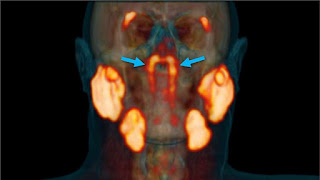
  Oncologists in the Netherlands were using PET/CT scans with prostate-specific membrane antigen ligands to track the spread of prostate cancer.  When a patient is injected with radioactive glucose, tumors are highlighted. But they ended up finding these glowing spots in all 100 people scanned and realized they had discovered an entirely new organ. They had found salivary glands, specifically mucous glands with multiple draining ducts.  It was previously believed that the only mucous glands in the nasopharynx were microscopic and spread evenly throughout the mucosa. For reference, the nasopharynx. These new glands have been dubbed "tubarial glands," and may be the cause of certain complications following radiation treatment, such as trouble swallowing (dysphagia). Now that medical professionals are aware of these glands, they can avoid damaging them with radiation therapy and lessen the side effects patients experience. IFLScience

Science is Fun Fridays!

Image
Today we'll be looking at the endocannabinoid system, and specifically, Clinical Endocannabinoid Deficiency. The endocannabinoid system is made up of: -enzymes which create and destroy cannabinoids -receptor sites on cells to receive cannabinoids (CB1 and CB2) -the endocannabinoids themselves, compounds produced by our bodies Together these mechanisms regulate body processes and functions, with the goal of achieving and maintaining homeostasis. Researchers believe that many ailments related to the immune system and inflammation could be due to endocannabinoid deficiency.   Dr. Ethan Russo: "Migraine, fibromyalgia, irritable bowel syndrome, and related conditions display common clinical, biochemical, and pathophysiological patterns that suggest an underlying clinical cannabinoid deficiency that may be suitably treated with cannabinoid medicines." CED may also play a role in diseases like Alzheimer's and Parkinson's. CB1 rece...