Posts

Showing posts with the label Fossils

Science is Fun Fridays!

Image
  The Singhbhum Craton in India is one of Earth's oldest surviving blocks of continental crust. Researchers came across a carbonaceous layer sandwiched in ancient chert - the mineral form of silicon dioxide - and there they found fossilized remnants of microbial mats. Some of these traces of life have been dated to 3.5 billion years ago. The silica entombed the dead microbes, preserving them as thin layers of carbon that can survive even as the surrounding rock is transformed by heat and pressure. First they had to establish that the carbon was indigenous to the rock, and not introduced by some later geological event, and then they had to prove a biological origin. They used Raman spectroscopy to determine its structure, which in turn reveals formation and alteration history.

Science is Fun Fridays!

Image
  In some follow up on yesterday's topic, I realized I didn't have any other mention of Dr. Louis Leakey. A paleoanthropologist and archaeologist, he found significant hominid fossils, including those of Homo habilis, demonstrating that humans evolved in Africa.  Homo rudolfensis' skull is on the left, with Zinjanthropus boisei on the right, a species of Australopithecus. From these findings and other curiosities, he helped pioneer the field of primatology. They discovered crude tools at the Olduvai Gorge site, identifying the oldest known stone tool-making tradition in the world.  Leakey felt that studying primates might help them better understand the behaviors of early hominids. Jane Goodall, as we know, studied chimpanzees.  Dian Fossey studied gorillas, and Birute Galdikas studied orangutans.

Science is Fun Fridays!

Image
  Pterosaurs have incredibly lightweight skeletons, so finding one intact is pretty rare. In the Solnhofen Limestones in Germany, paleontologists came across a perfectly preserved hatchling.  And it is tiny, with a wingspan of less than 20 centimeters. "The odds of preserving one are already slim, and finding a fossil that tells you how the animal died is even rarer," reports lead author, Rab Smyth, from the University of Leicester Centre for Paleobiology. The fractures suggest a powerful twisting force, such as a severe storm, that caused catastrophic injuries. It should be noted that several young pterosaur fossils have been found in this area, and now scientists understand why - adults would likely have survived the storm. Here they explain the conditions:

Science is Fun Fridays!

Image
 Nilpena Ediacara National Park in Australia is home to the oldest fossils in the world. Millions of years ago, the Southern outback was part of the coastline, and a shallow seabed teeming with some of the first lifeforms on the planet - ediacaran biota.  These were mostly tubular and frond-shaped, immobile. "There are around 60 places in the world that have Ediacara fossils...  Elsewhere, you might be looking at a few individual specimens, but here, we're pulling out whole sections of the sea floor and piecing it back together," reports Kim Geue, the ranger in charge. Whole ecosystems are being revealed, containing tens of thousands of preserved specimens. The Australian government is pushing to have the surrounding Flinders Ranges designated a UNESCO World Heritage Site.

Science is Fun Fridays!

Image
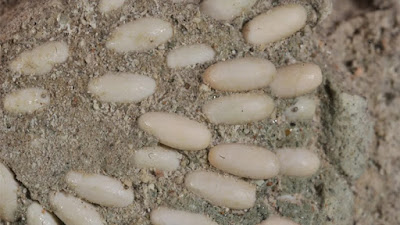
29 million-year-old grasshopper eggs found in John Day Fossil Beds National Monument in Oregon. They're called "ootheca," a type of egg capsule produced by stick insects, cockroaches, praying mantises, and grasshoppers. Different species make their oothecae in different ways, creating a variety of egg pods. Many grasshopper species lay their eggs by inserting their abdomen into the soil and making excretions that mix with the soil and then harden.  The result is their eggs take on the shape of the surrounding soil. Chris Stacey, Flickr

Science is Fun Fridays!

Image
  10-12 million years ago, a Yellowstone hotspot erupted and blanketed a watering hole with ash. Today, Ashfall Fossil Beds is a State Historic Park in Nebraska. Above are the fossils of Teleoceras, an extinct grazing rhinoceros.  The site also includes small three-toed and one-toed horses, camels, a saber-toothed musk deer, as well as birds and turtles. Researchers have determined through the bones that the animals died of lung failure from inhaling the ash.  Several bones showed marks from scavenging predators, such as the bone-crushing dog, Aelurodon. In 1971, someone noticed a skull sticking out of a gully at the edge of a cornfield.  That someone happened to be a University of Nebraska State Museum paleontologist, who recognized it was that of a juvenile rhinoceros.  The area was purchased by the Game and Parks Foundation in 1986, and became and National Natural Landmark in 2006. Teleoceras

Science is Fun Fridays!

Image
 #FossilFriday This is a 500 million year old fossil of Stanleycaris hirpex , found in the Burgess Shale.  It is one of 84 exceptional specimens found by the Royal Ontario Museum in Canada. These fossils include three eyes and visible brains, and they're even able to make out fine details such as visual processing centers. The species was a Radiodont, whose closest living relatives are arthropods. What they've noticed in the brain are two components - one connected to the eyes and the other to frontal claws, which are depicted in this artist representation. Since modern arthropods have three sectors, this is an important piece of the evolutionary chain. IFL Science

Science is Fun Fridays!

Image
Hubby and I were watching "Dino Hunt" before bed last night, and a lot was taking place in Dinosaur Provincial Park in Alberta.  I wanted to share a few of those findings. #FossilFriday! This is Borealopelta,  a relative of the Ankylosaur.  It is so well preserved that skin and soft tissues remain, and scientists have been able to determine its color based on lingering pigments. Scientists believe this animal drowned somehow and its body taken out to sea, where it floated belly up until gases released, causing the dinosaur to sink.  It hit the ocean floor hard enough to leave a small crater, and was then covered by fine sediment that encased it for millions of years. Artist Representation Royal Tyrell Musem of Paleontology In a bone bed along Milk River, a new species of Ceratops was found and named for the woman who first found the spot - Wendiceratops.  They knew when they found the horn pattern along the frill that they had somethin...

Science is Fun Fridays!

Image
Thousands of fossils have recently been found in Colorado Springs, and they provide information regarding mammal growth following the KT mass extinction.  65 million years ago, a meteorite crashed into the Yucatan peninsula, killing more than 3 quarters of life on Earth. The Corral Bluffs are "a known hotbed of the KT boundary."  Tyler Lyson, a paleontologist for the Museum of Nature and Science, along with Ian Miller, an expert on prehistoric vegetation, were roaming the area in 2016 when Lyson decided to crack concretions instead of scanning for bone bits.  He immediately found the cross section of a mammal skull.  And thus began their dig. Their study reports on numerous fossils representing 16 animal species and more than 6,000 plant fossils, including pollen grains.  One of the cranium bones found belong to a newly discovered species, Loxolophus. The trend in fossils shows a rapid recovery from the time of the extinction to the ...