Posts

Showing posts with the label Microscopic

Science is Fun Fridays!

Image
Vampire Virus! For the first time ever, a virus has been observed attaching to another virus. The satellite virus (purple) literally bites the neck of the helper virus, on which it relies to complete its life cycle. A team of undergraduates were analyzing the sequences of bacteriophages when they saw what they thought was a contamination.  They repeated the experiment and found the same, and upon further inspection found the presence of these helper viruses, 80% of which had a satellite. They also found some without a satellite had bite marks, suggesting previous attachment. Additional bioformatics done on a particular pair suggests their interaction is ancient, co-evolving for at least 100 million years.
Science is Fun Fridays!

Image
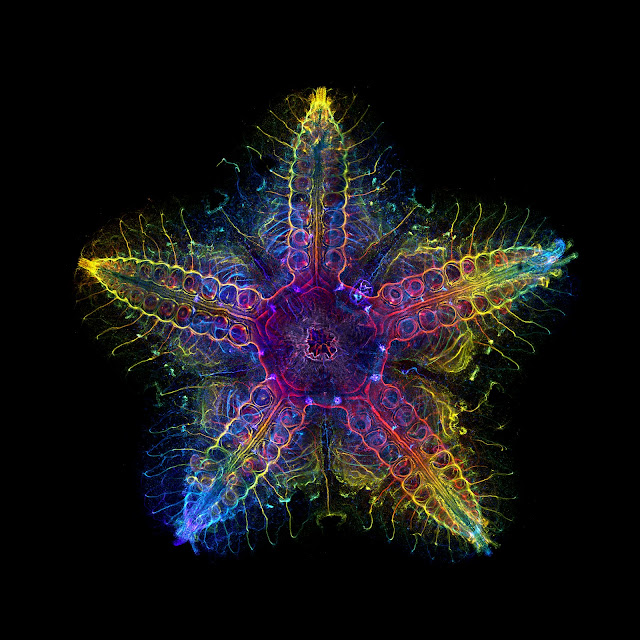
 Global Scientific Light Microscopy Awards Global Winner: Laurent Formery Nervous system of a juvenile sea star. Materials Science: Shyam Rathod Crystal of a topical wart treatment. Americas: Igor Siwanowicz Germinating pollen grain of a morning glory. Europe, Middle East, and Africa: Javier Ruperez Scales of the wing of a Madagascan sunset moth. Asia-Pacific: Jiao Li Edelweiss stamens. Honorable Mentions: Katelin Murphy - Dorsal view, red-backed salamander skull. Uriel Ruiz - A unicellular microalga with three horns. Robert Berdan - Cross section of a blue spruce branch.

Science is Fun Fridays!

Image
 Beetle Butt! That's right, that pretty magenta center is actually poop.  The gray layer is the intestine, and the purple is the malphigian tube, (an excretory organ). Researchers are studying this to understand how beetles use their butts to stay hydrated. Beetles are able to open their rectums and take in moisture from the air.  They convert this into fluid that they can then absorb into their body.  Their specialized organs can also extract water from food, so that beetles often go their entire lives without drinking liquid water. Such as the Scarab, or Dung Beetle, of the Sahara. "There is twenty times as much insect biomass on Earth than that of humans.  They play key roles in most food webs, have a huge impact on virtually all ecosystems and on human health.  So we need to understand them better," says lead researcher, Kenneth Veland Halberg.

Art Class - Microscopic Cocktails

Image
 I'm fairly certain I posted this back during the Channel days, but I was reminded today so here we go! Vodka Tonic Piña Colada Gin Dry Martini Tequila English Oatmeal Stout Chablis Fuzzy Navel Irish Pale Lager I'd definitely hang that one up in my house.

Science is Fun Fridays!

Image
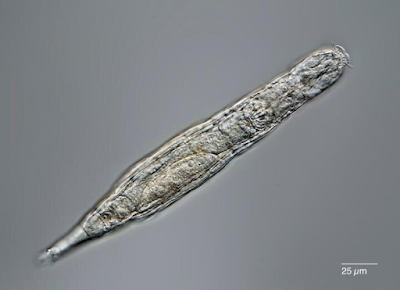
  The Bdelloid rotifer was discovered in the permafrost of Siberia, where it has lived for 24,000 years! These multicellular animals are known for surviving extreme conditions - starvation, freezing temperatures, low oxygen, even ionizing radiation.  But scientists did not know they could endure dormancy for so long. Once it was thawed, it was able to reproduce asexually, no problemo. They used radiocarbon dating to verify the age of the rotifer, and will study further to understand how exactly it was able to remain in a state of cryptobiosis for so long.  Previous research said they could survive only 10 years frozen. The team drilled into the permafrost along the Alayeza River and samples were taken to the Soil Cryology Lab at the Institute for Physiochemical and Biological Problems in Soil Science, located in Pushchino, Russia. The lab specializes in separating microscopic organisms from the permafrost and have successfully regenerated several multicellular animals, mo...

Science is Fun Fridays!

Image
  The adorable, microscopic tardigrade, also known as the water bear. They can live just about anywhere - they can survive radiation, boiling liquids, massive pressure and even the vacuum of space.  They're likely to keep on kicking long after we've been wiped out. One aspect of their survival relies on cryptobiosis, a near death state they can enter by rolling into a dehydrated ball, (called a tun), retracting their head and legs.  Once they're back in water, they come back to life, so to speak.  In 2016, scientists revived two tuns that had been in cryptobiosis for 30 years! They can also form a special tun that prevents the growth of ice crystals in cold temperatures. When oxygen is low, they can stretch out which reduces their metabolic rate and their muscles can absorb enough oxygen and water to survive.  And regarding radiation, they're able to produce a protein which protects their DNA from damage. For food, water bears suck the juices from algae, lichens...

Science is Fun Fridays!

Image
Thalassionema nitzchioides - Phytoplankton in the pennate diatom group. These microscopic algae, alone, are straight bars thinner than the thinnest strands of hair - together, they form stars and other zig-zag patterns. These cells form their own art, but microscopists have been tinkering with diatoms for centuries.  In 1891, JD Möller created this piece: Today, Klaus Kemp is the go to artist. There is a short documentary about Mr. Kemp called "The Diatomist." Smithsonian IG EOAS Smithsonian Magazine